
By Ana Gotter — Last updated: 2026-04-16
Case studies are the cheapest credibility your marketing site has. A live customer story turns a product claim into proof — and the strongest ones get cited, shared, and stolen from for years.
The 17 examples below are all live, all B2B, and all do at least one thing worth copying. We’ll show you what each one gets right, what format it picked, and how to adapt the move for your own campaigns. Start with the comparison table if you only have a minute.
Which Case Study Type Fits Your Goal?
Case study format should follow the job. A long-form report and a one-pager both sell — just to different readers, at different points in the funnel. Use the table below to pick the format before you pick the story.
| Format | Best for | Why it works |
|---|---|---|
| Long-form report | Complex, multi-stakeholder, or technical B2B deals | The space to cover the full arc — context, decision criteria, rollout, results |
| One-pager | Sales enablement, outbound follow-up, trade-show handouts | Reps and prospects get the headline claim at a glance |
| Video | Brand lift, social reuse, emotion-led pitches | The customer tells the story in their own voice — harder to fake than a paragraph |
| Interactive web story | SEO, shareability, editorial polish | Mixes media and scroll without trapping the reader inside a PDF |
| Infographic / graphic-led | Stat-heavy proof, top-of-funnel promotion | Numbers land faster as visuals than as prose |
| Podcast / audio | Thought leadership, founder and operator audiences | Long-form attention from a reader segment that already skims everything else |
Format guidance adapted from Adobe and RingCentral.
How to Write Great B2B Case Studies
Before we look at the examples, a quick recap of what separates a case study that converts from a case study that reads like an outsourced puff piece.
What All Great B2B Case Studies Accomplish
Great B2B case studies build trust by proving you got a specific result for a client a reader can see themselves in. The best ones do all five of these:
- Establish a persona or audience segment the featured client fits into
- Explain the client’s problem before they started working with your brand
- Detail the solution — strategies, products, and tactics, not just tool names
- Share specific, numerical results. The more concrete, the better
- Include an impact statement or testimonial from a named stakeholder
If you’re not sure which persona to anchor the story to, start with your ideal customer profile — the closer the case-study subject mirrors it, the more readers will convert.
B2B Case Study Best Practices
- Stick to a consistent template so the case-study library on your site stays scannable as it grows.
- Tell a story. Problem = setup, solution = climax, results = resolution. Readers remember arcs, not bullet lists of features.
- Be detailed where detail matters, brief everywhere else. B2B case studies can run long; padded ones get abandoned.
- Always include hard facts. Statistics, tactical decisions, and quantifiable data carry the piece and give you a magnet headline.
- Format for skimmers. Pull quotes, subheads, side panels, screenshots. Nobody reads an 800-word wall of text about a fintech rollout.
1. Breadcrumbs
We had to put this one first. Breadcrumbs has a library of content-driven case studies that hit every box: the client’s problem, the solution, the results, and a named testimonial.
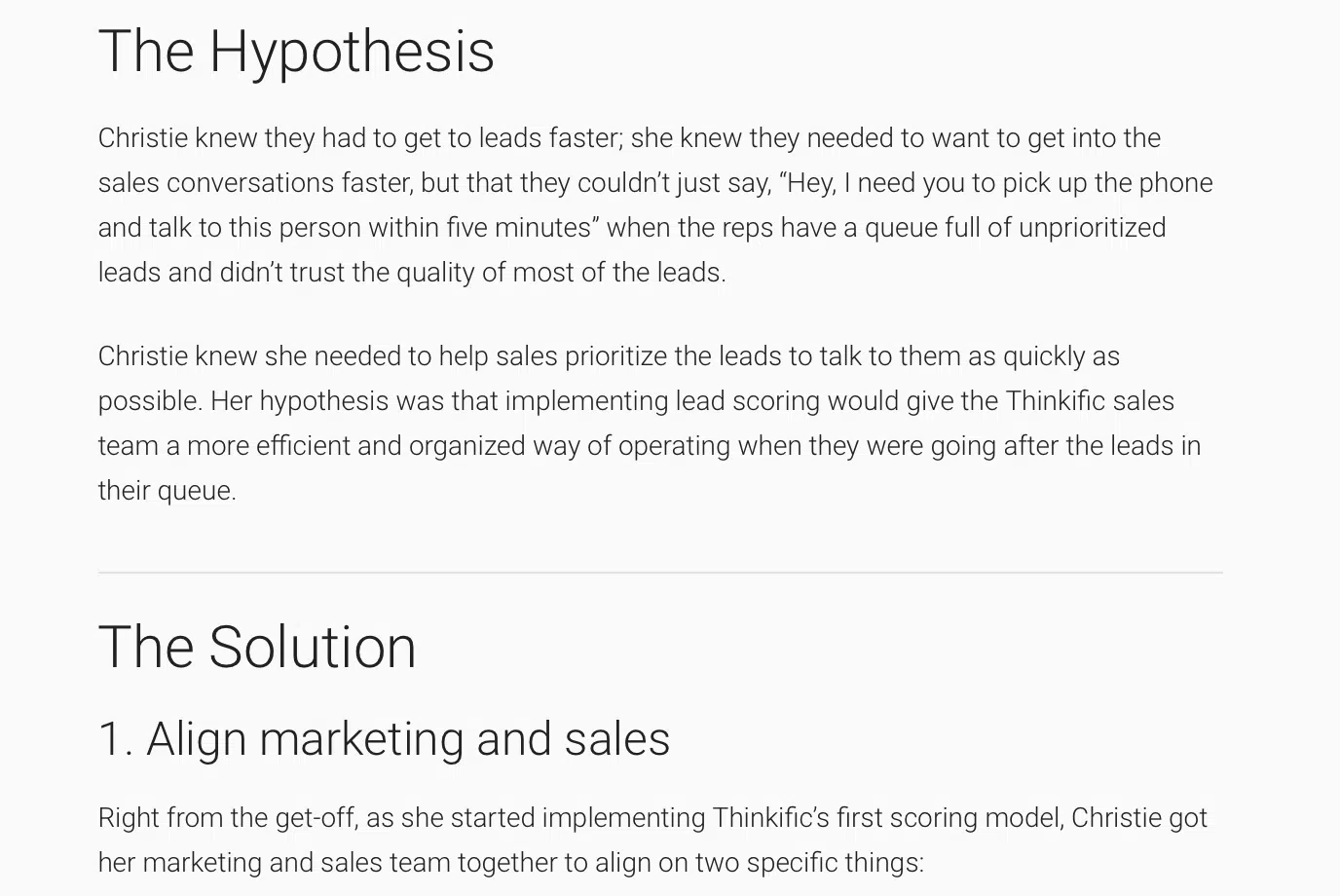
What the Breadcrumbs case studies do differently is the content-first framing. They’re not boasting about results — they share enough actionable detail for another company to replicate the play.
Take How to Reduce Your SLA by 99.9%. The client did reduce their SLA by 99.9%, but the study walks through how so the reader can use B2B lead scoring to do the same.
The asset is downloadable, sits next to a "Start Free" CTA, and opens with a "What you’ll learn" section — framing it as content, not just a brag sheet.
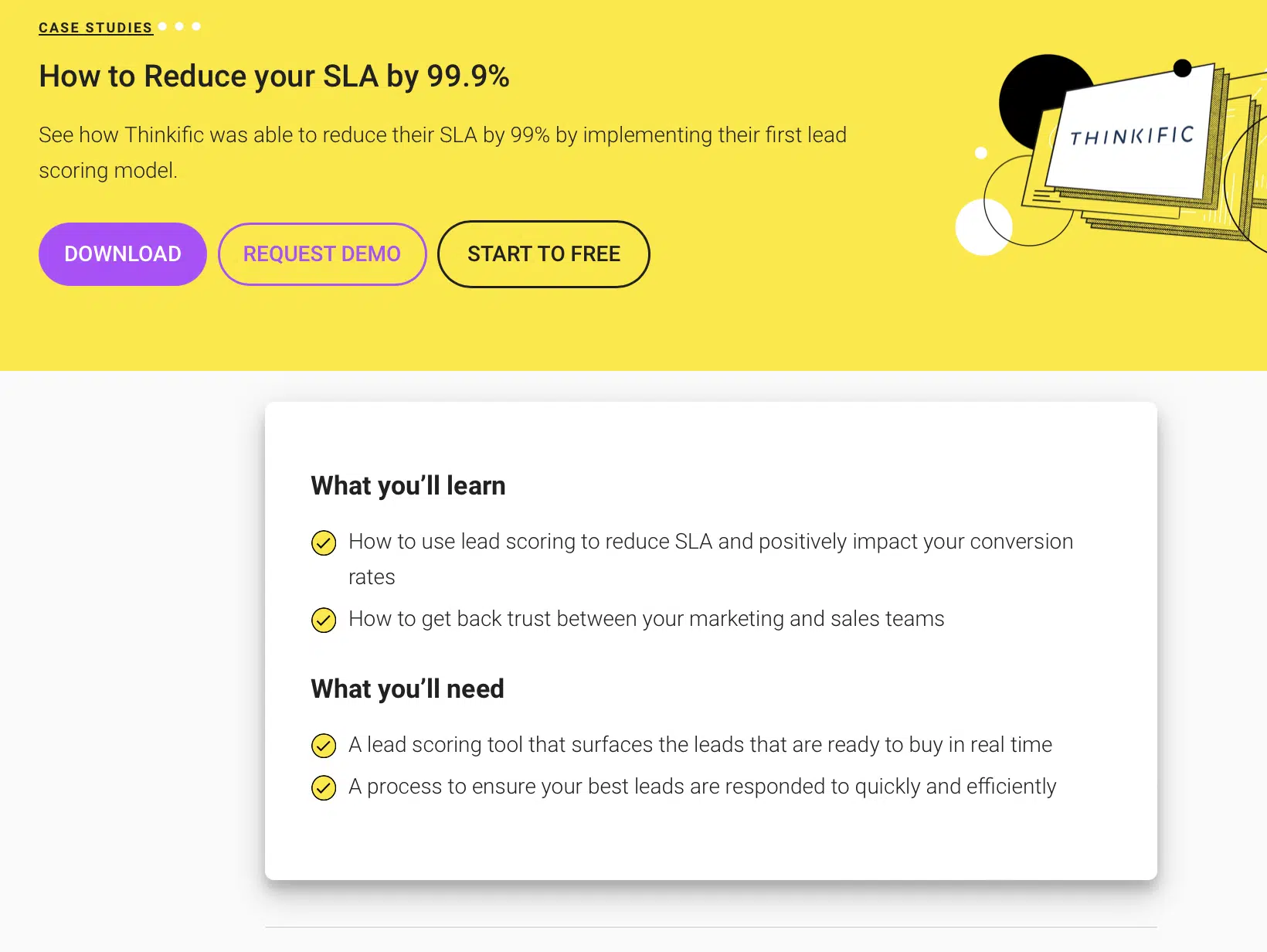
One more thing worth copying: the case studies refer to individual client contacts by first name and use a conversational voice. Most B2B case studies read cold and clinical. Readers don’t buy from logos — they buy from people at logos. Warm the tone up.
2. AdEspresso
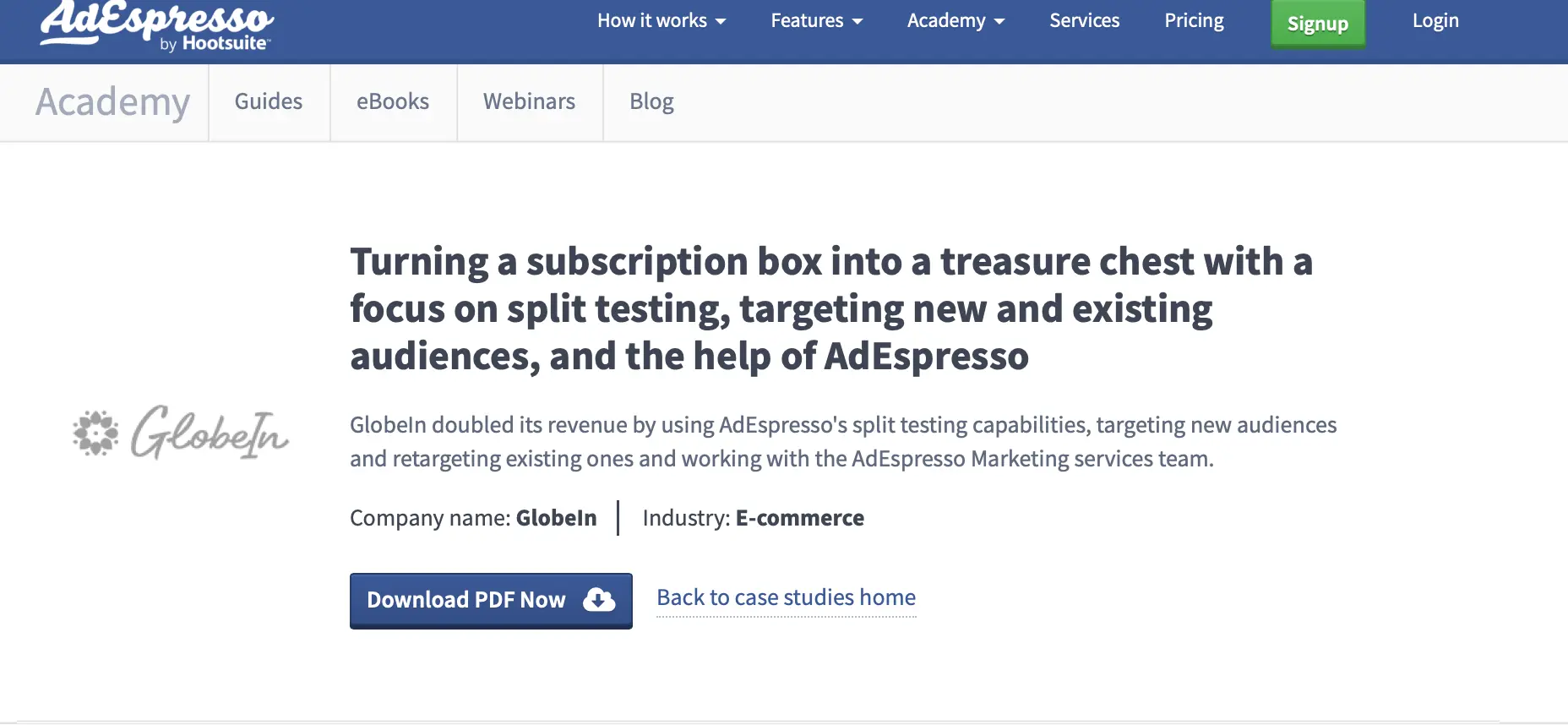
Want your case study to double as a lead magnet? AdEspresso’s GlobeIn study is the template.
Here’s how the play works:
- The landing page leads with the brand name and the accomplishment, then a split-testing-and-targeting summary of the approach.
- The headline result is stated upfront in plain language so the reader knows the payoff before they commit to reading.
- The CTA asks for a PDF download, which sends users to a landing page with a lead form.
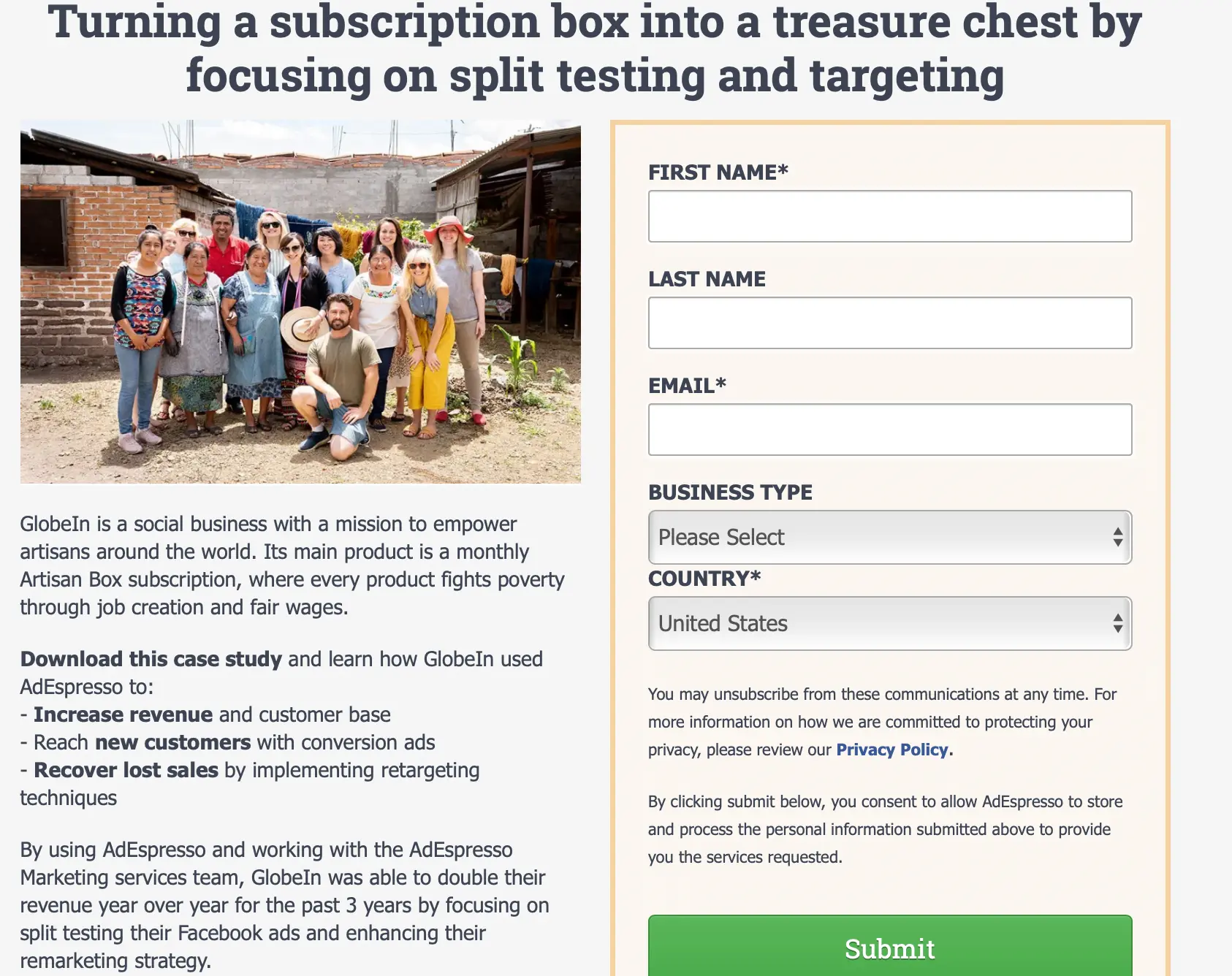
The landing page teases additional results but keeps the full strategy inside the PDF. This works because the case study gives away enough tactical insight to feel like a blog post — not just a brag.
If your case studies are heavily strategy-led instead of numbers-led, they become a genuinely new touchpoint in the sales funnel rather than just social proof.
3. FreshBooks
Most B2B buyers have multiple personas inside the same ICP. The case-study library that talks to each one wins.
FreshBooks does this well. The Neil Chudgar story features a named consultant who used time tracking and the platform to double his revenue in a year — the exact relatable SMB persona FreshBooks sells to, not a Fortune 500 CFO.
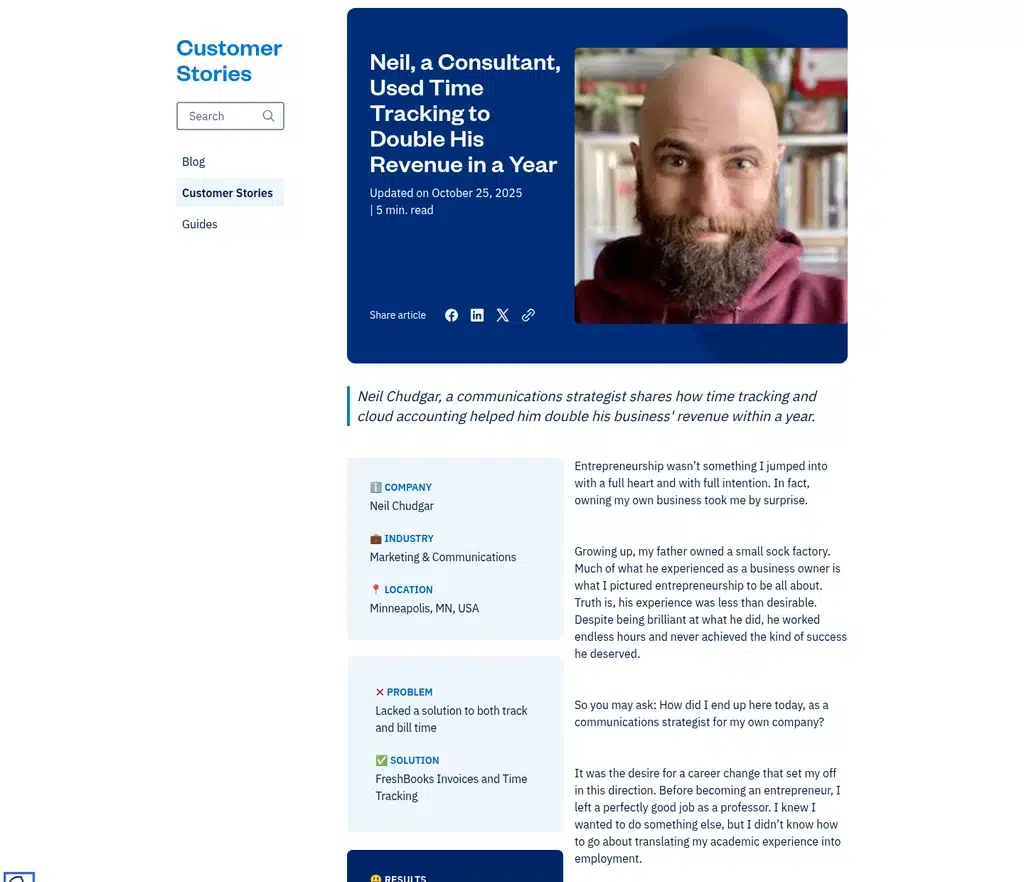
The story names the consultant, his firm type, his specific workflow change (time tracking), and the concrete business outcome (revenue doubled). That is the whole template for a persona-led B2B case study: one real customer, one specific change, one specific result.
If you’re evaluating which customers to feature, start with the segment you want more of — then pick a story from a customer who looks like them. That is simpler than it sounds, and it is where most B2B case-study libraries go wrong.
4. Disruptive Digital
Disruptive Digital is a paid social agency, and its case studies are built into its blog posts — not bolted onto a separate library.
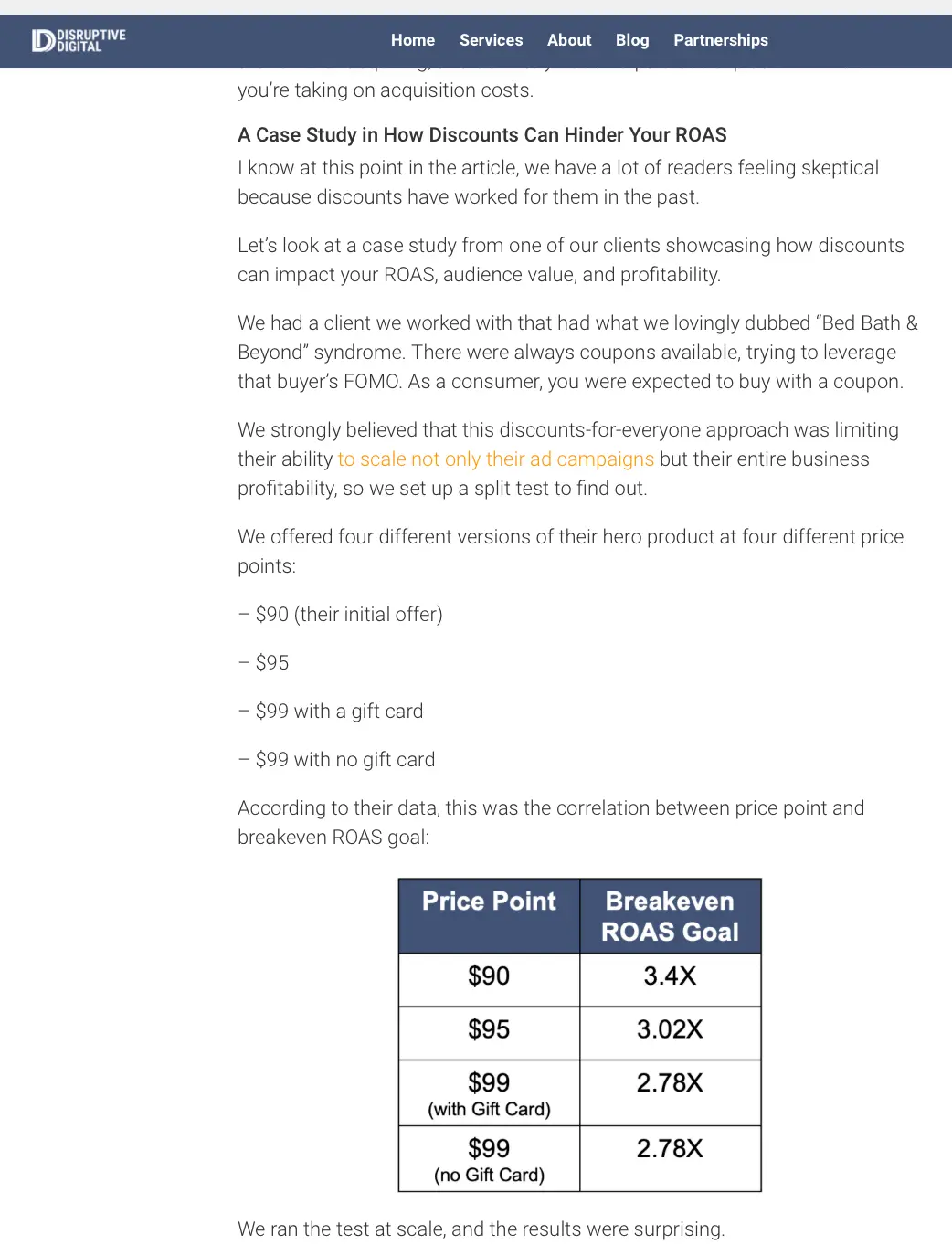
A blog post about "how to calculate your target ROAS" carries a worked case study with real client data. That’s more powerful than hypotheticals when you’re selling on the promise of data-driven PPC.
Embedded-proof case studies work at the top of the funnel. They build trust while a reader is still learning, which is exactly when most competitors are pitching a demo.
5. CoSchedule
CoSchedule is the SaaS content and social-media planning tool, and its case studies are one of the cleanest templates on this list.
The study leads with a benefit-heavy headline — "This 5-Person Marketing Team Managed 12x More Work While Working Remotely" — across the top of the page in bright contrast. A quick-facts side panel lists the brand, site, industry, company size, and marketing-team size. A PDF download and a CTA sit right below the hero.
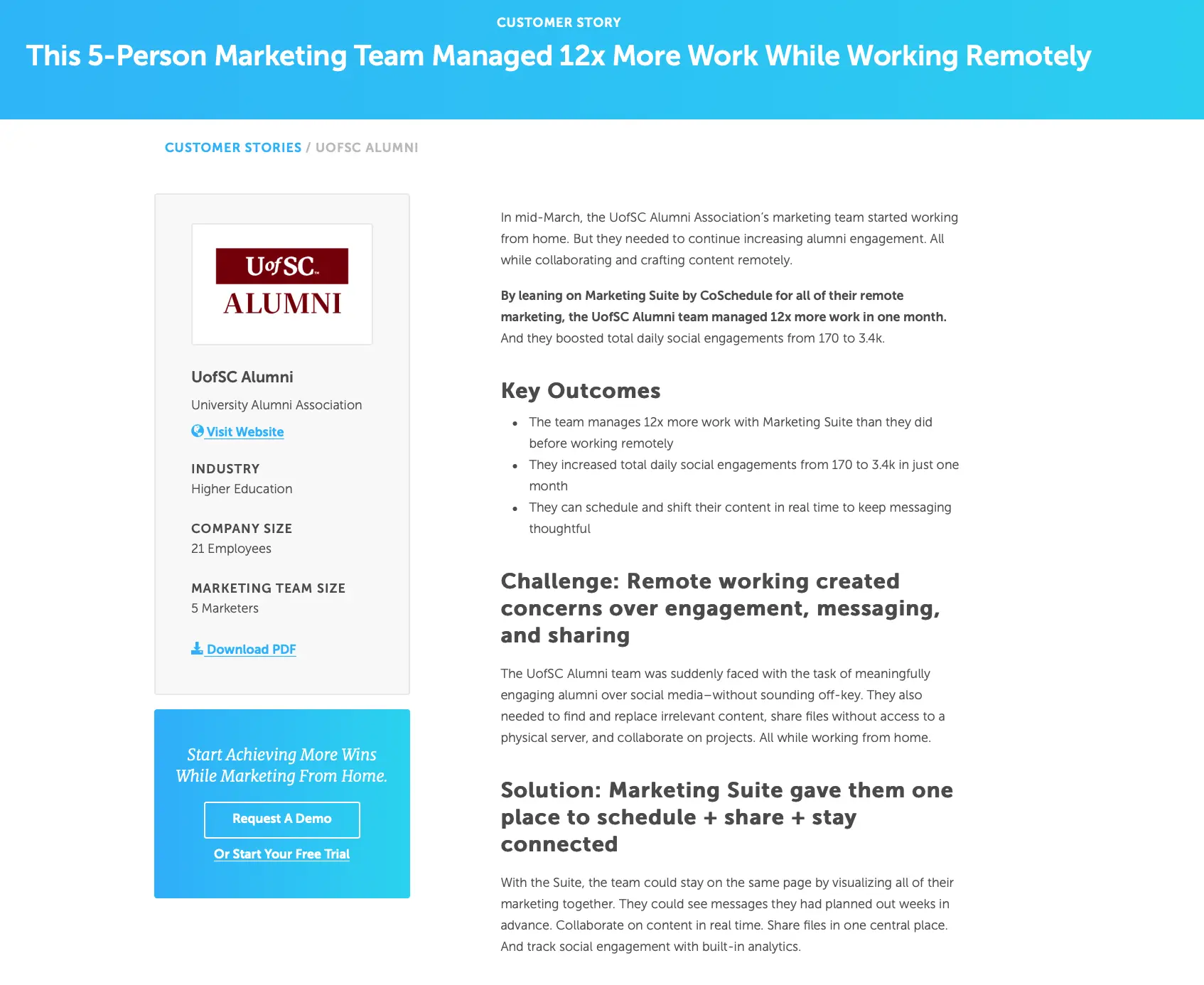
The body follows the challenge / solution / results arc. A graph in bright colors carries the headline outcome, and a pull quote from a team member closes it out.
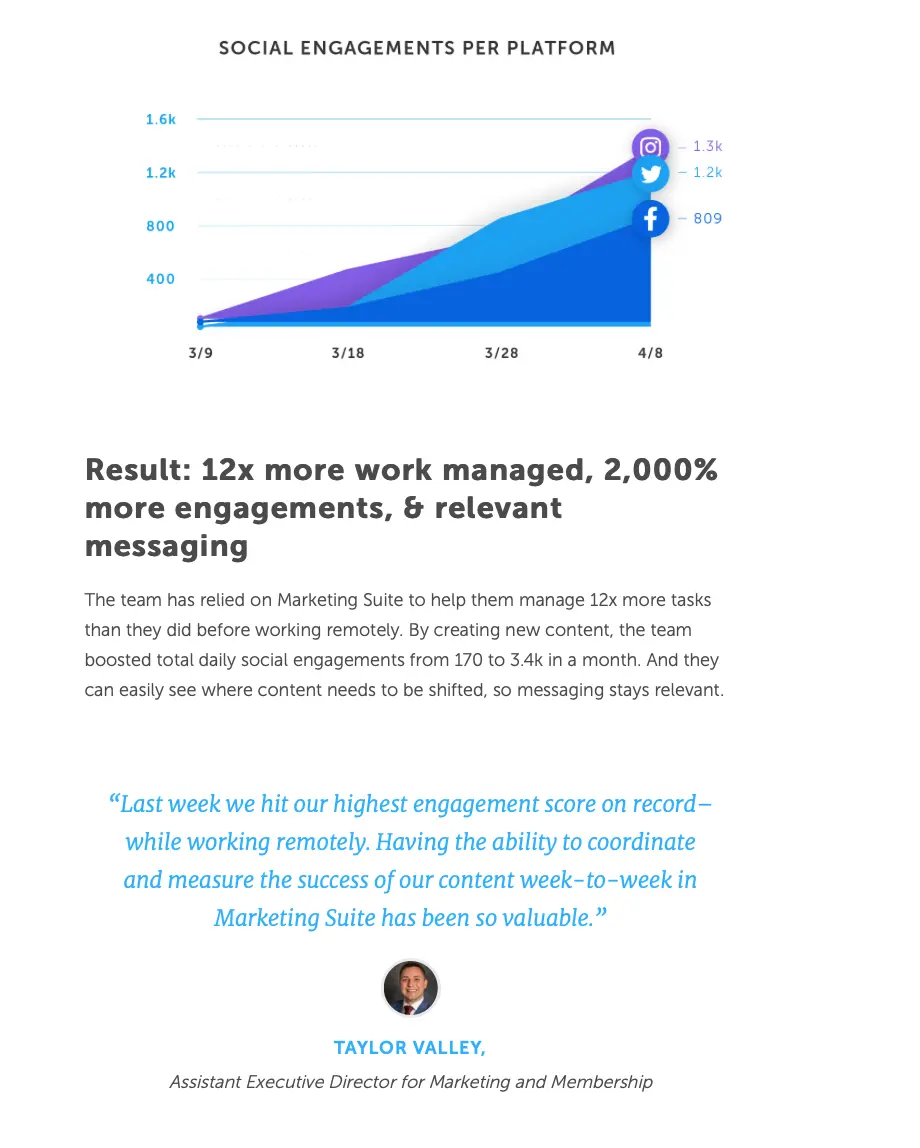
If you are building your first case-study template, start here. Quick-facts panel, headline metric, challenge-solution-results arc, stakeholder quote, CTA. Five moves, every time.
6. RingCentral
RingCentral’s Ryder Systems case study is the enterprise-software template most B2B teams should study.
Ryder is a Fortune 500 logistics company with nearly 800 locations — exactly the kind of credibility logo that sells into the rest of the enterprise market. The study opens with the company context, moves into the transition from legacy phone systems, and lands on concrete operational outcomes.
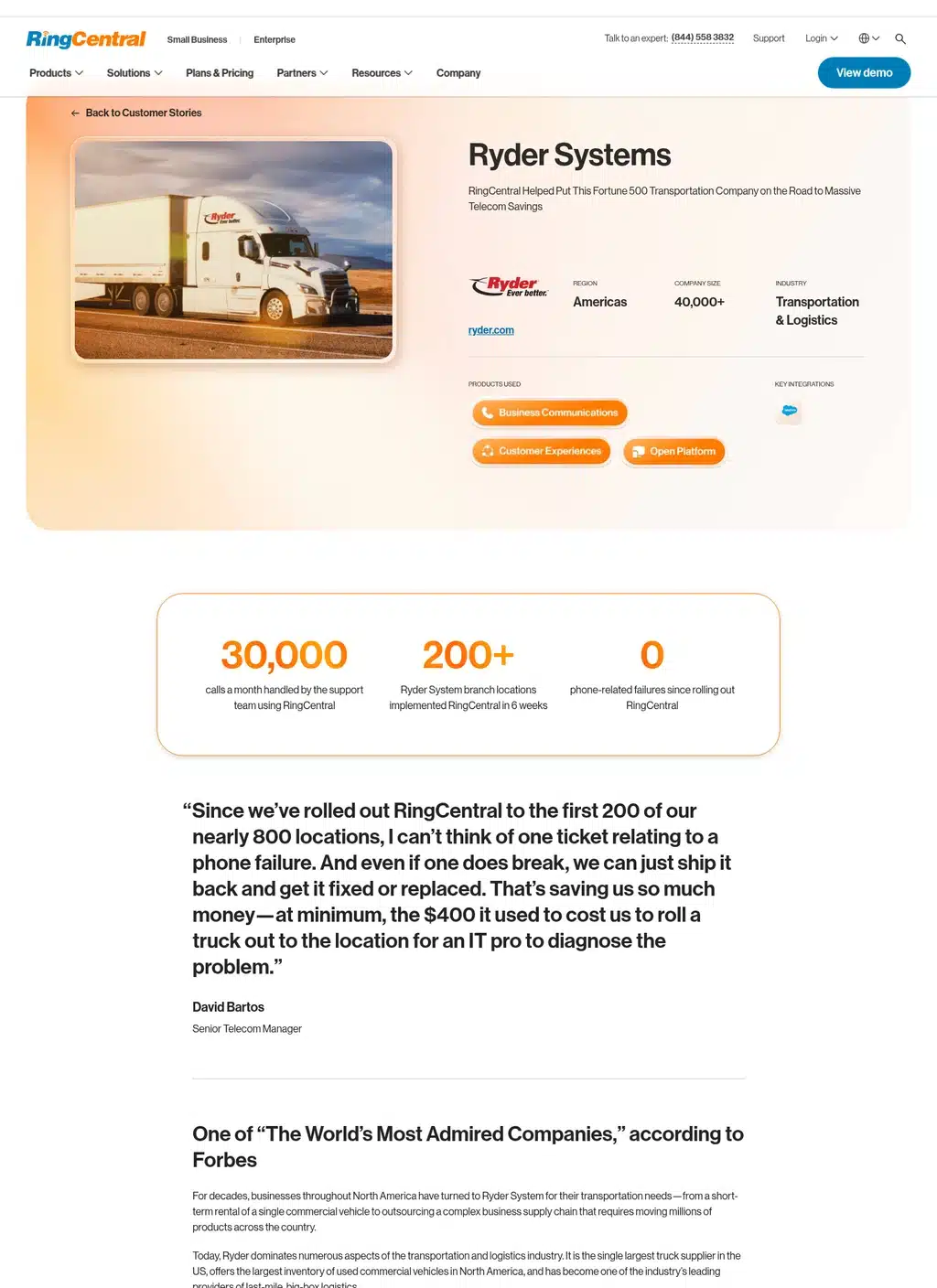
What makes this worth copying is the quote from David Bartos, Senior Telecom Manager at Ryder: "Since we’ve rolled out RingCentral to the first 200 of our nearly 800 locations, I can’t think of one ticket relating to a phone failure." That single sentence does more conversion work than a dashboard of metrics.
Named stakeholder, concrete number (200 of 800), specific operational outcome (zero failure tickets). If you want to rebuild an enterprise case-study template, that formula is the whole thing.
7. Slack
Slack’s Shipt case study reads more like a story-driven blog post than a brief-and-to-the-point study. It works because storytelling is more memorable than a spec sheet, and Slack has the brand altitude to pull it off.
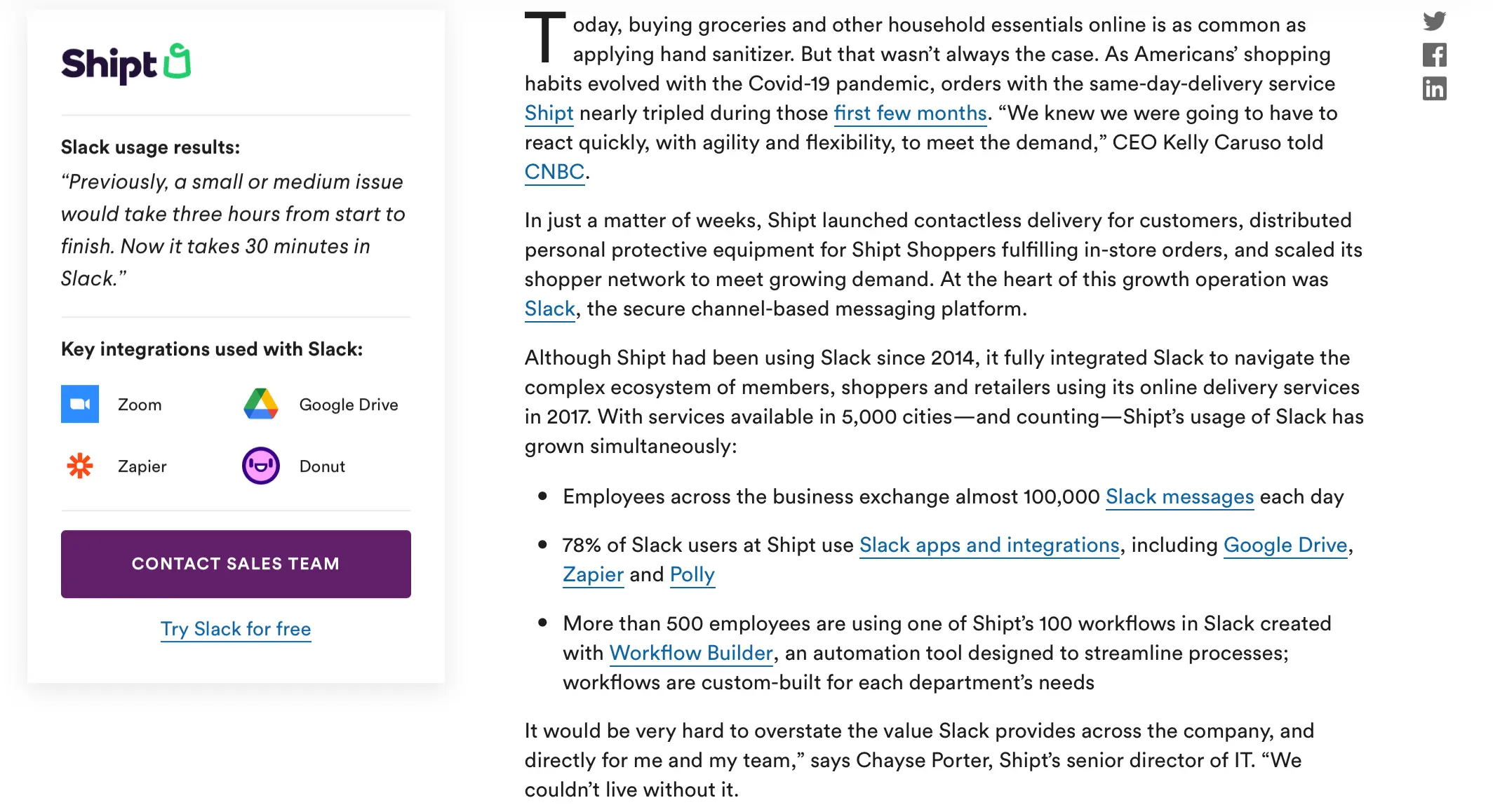
The study walks through Shipt’s grocery-delivery growth, the Slack features the team leaned on, and the integrations that kept operations moving. Usage data and statistics show up mid-story instead of leading the page.
A quote from the director of IT sits alongside a quick-facts tab with featured integrations, plus two CTAs — one for sales, one for the free product tier.
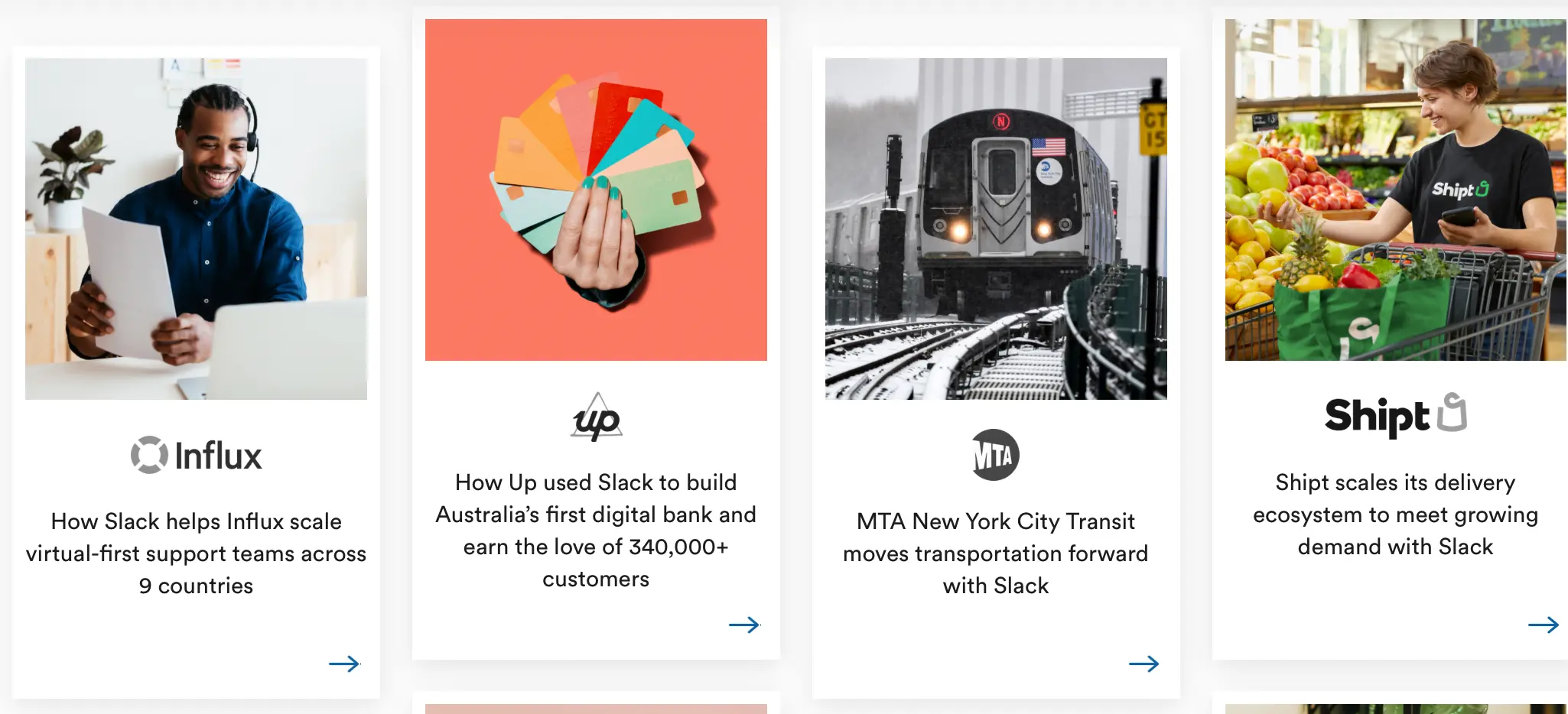
Slack’s whole case-study library commits to storytelling over data-upfront. It feels casual. It still converts — because the stories are about real operational wins, not vibes.
8. Airtable
Airtable’s Taylor Guitars customer story is a good example of a humanized B2B case study — recognizable brand, named stakeholders, media-rich layout, quotes that sound like a human wrote them.
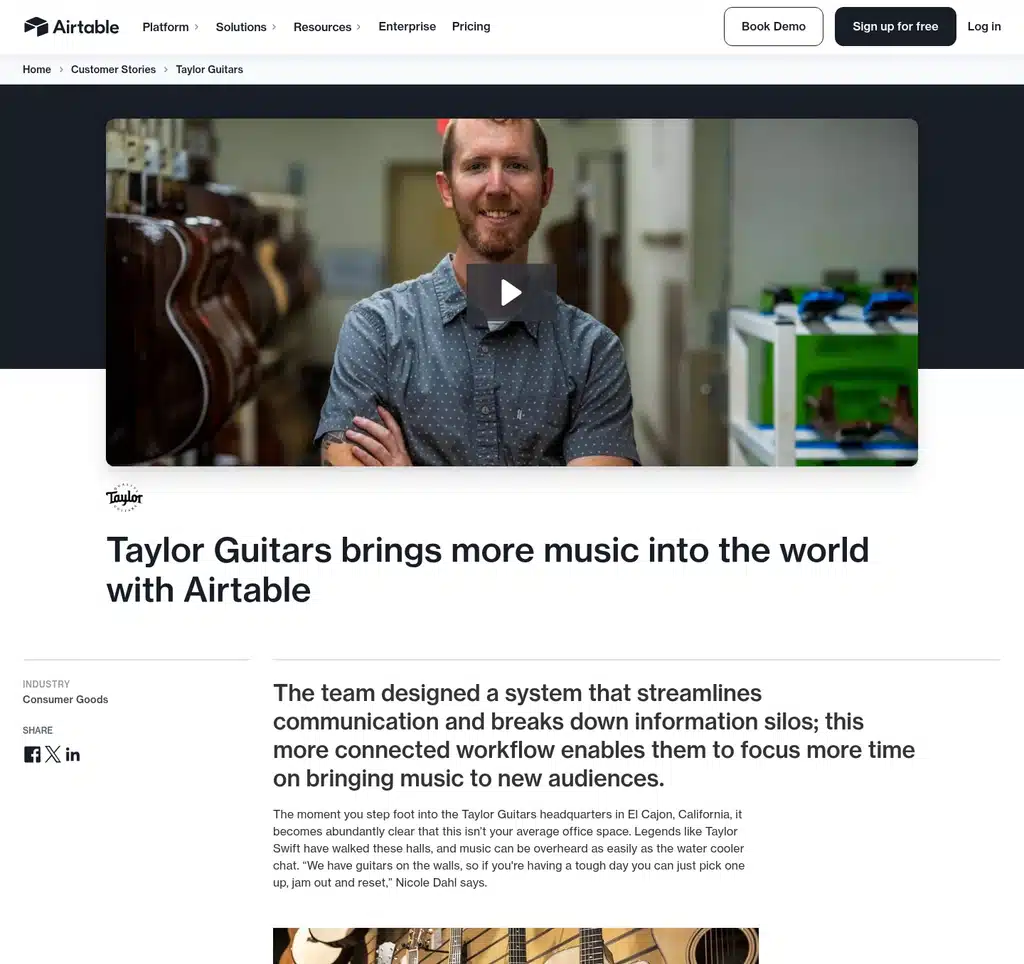
The story introduces named team members at Taylor Guitars — including a project manager and a social media manager — who walk through how the tool replaced siloed workflows and saved the team hours a week on admin. It runs longer than a one-pager, but the writing keeps the reader engaged: it explains how the team uses the product, not just that they use it.
The takeaway: let your customers sound like people. Prose that reads like a real team member wrote it converts better than a bullet list of adoption metrics — even on a B2B page.
9. KlientBoost
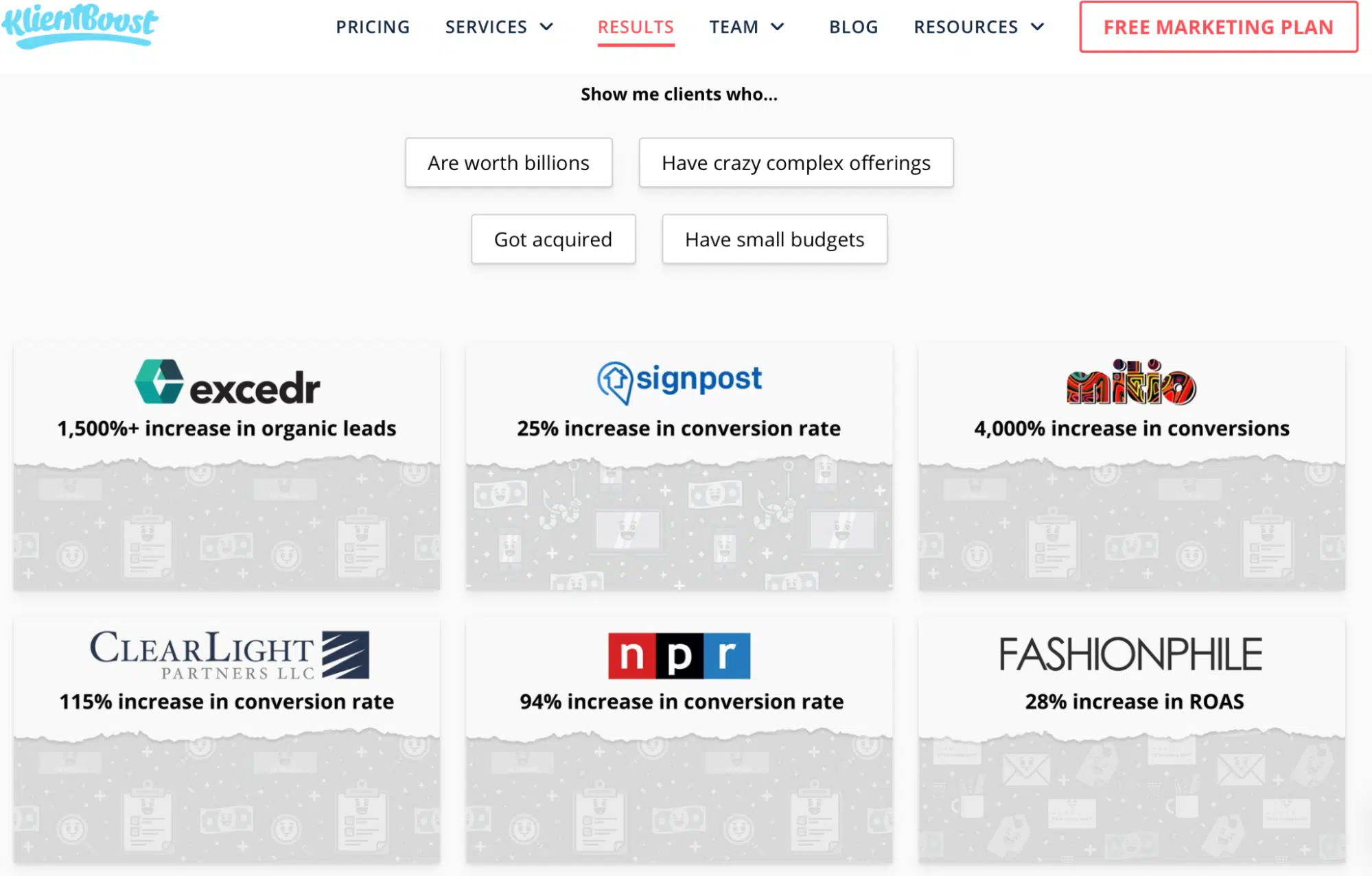
KlientBoost’s Results hub is one of the best case-study landing experiences on this list. Every case study sits under a single "Results" tab, making the library readily findable.
The sorting filter is the standout move — prospects can sort by "worth billions," "got acquired," "have small budgets," or "have crazy complex offerings." That single UI choice lets every ICP segment find a case study that looks like them.
The Signpost case study PDF itself is a masterclass in paid-media case study design. A color-contrasting hero carries the core benefit, with granular results on the side.
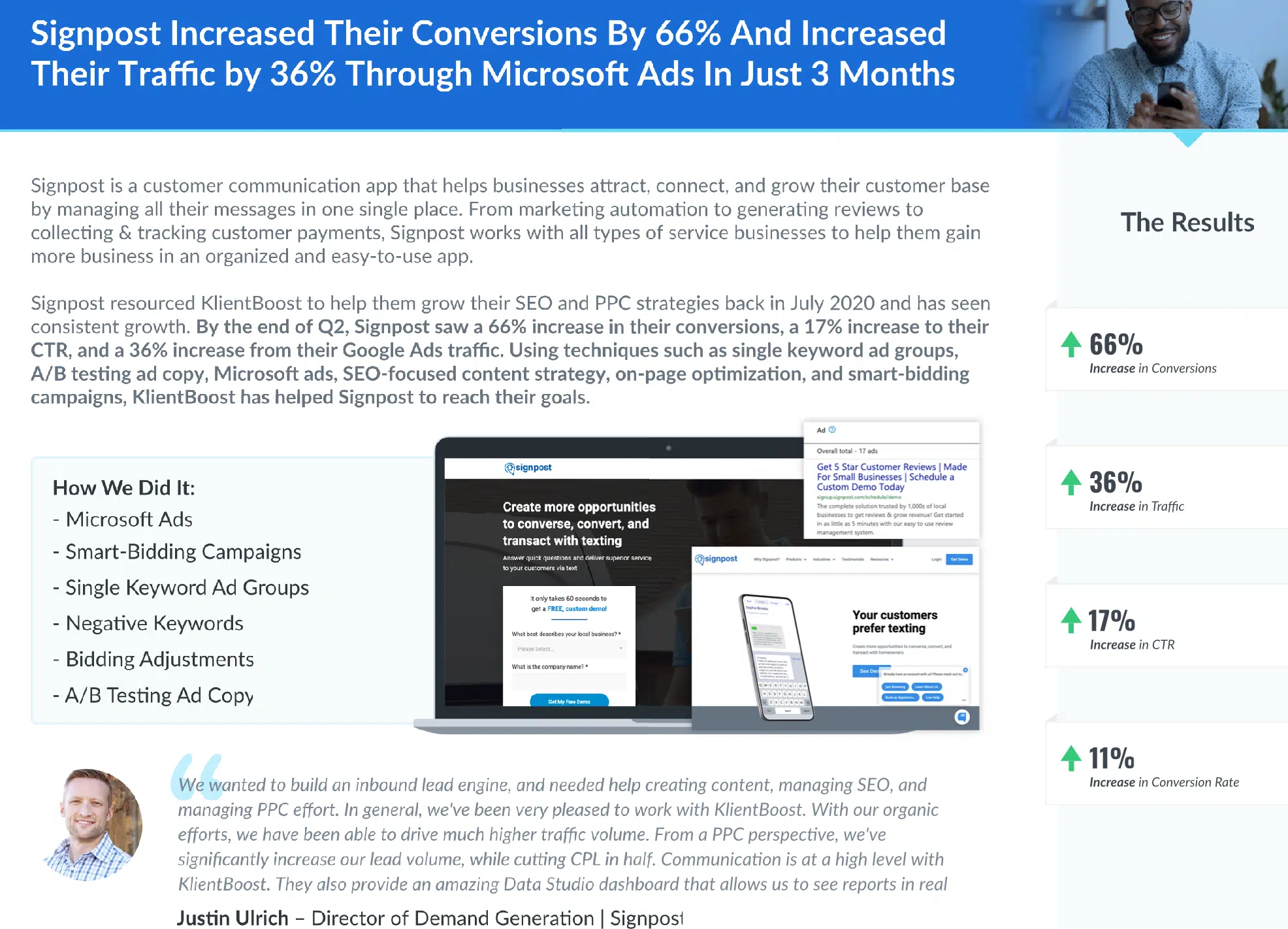
The study breaks down the advertising tactics used, a customer quote, and an image of what the ads actually looked like. Prospects see exactly what they’d get from the agency, which closes the loop on prospecting work.
10. Olo
Olo’s Ready case study is a good template for hyper-niche B2B — restaurant tech, highly specific use case, moderate numbers, rich context.
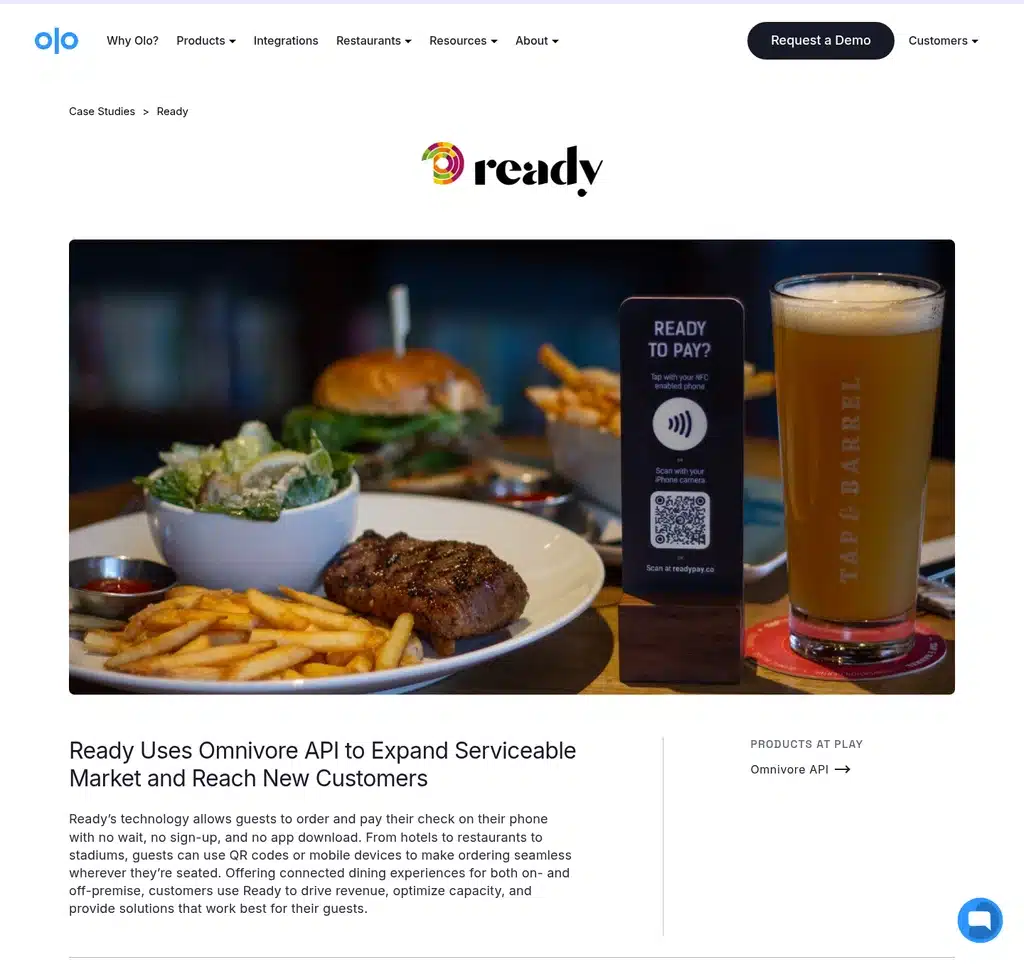
The study presents like a blog post with a benefit-led H1 and a creative subhead that frames the challenge. It then explains how the integration between Olo and Ready delivers a specific guest-experience outcome — mobile payments, table-side service, and a cleaner operations stack for the restaurant.
Notice what is not here: a wall of numbers. That is fine. For audiences buying on use-case fit more than aggregate metrics, showing the integration works is more persuasive than showing it moved KPI X by N%. Pick the proof that matches how your buyers actually evaluate.
11. Pepperi
The Pepperi case study of Chex Finer Foods runs six pages — much longer than most on this list.
It works because the "Challenges" section is brief and the client breakdown is visible upfront, so readers know whether they’re the audience before they commit.
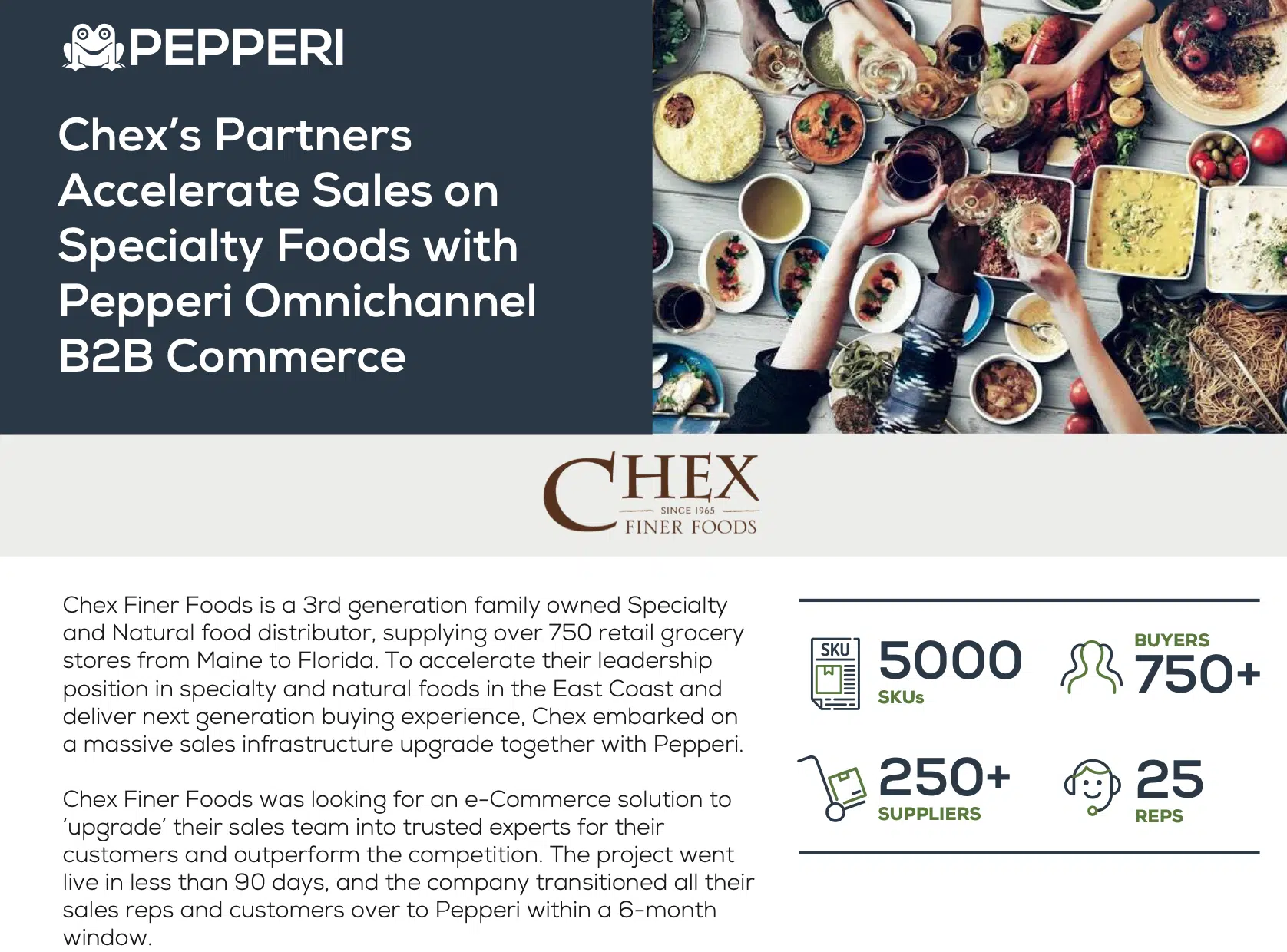
The solutions section is equally brief and sits on the first page. Everything after that is product proof: five pages of visuals showing the exact mobile app interface, the ordering site, and the home page.
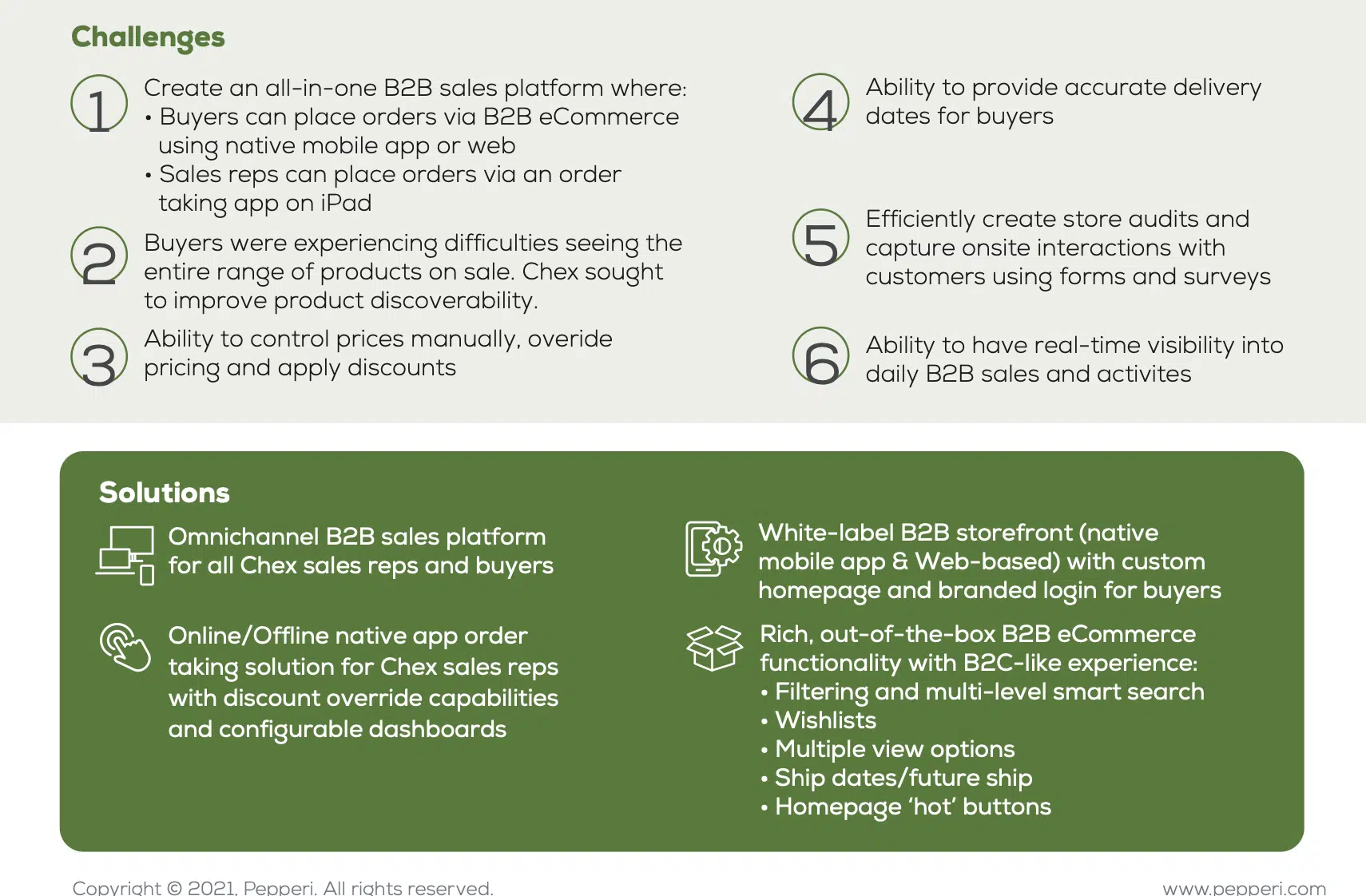
Later pages show search behavior for brands with large inventories, plus analytics and multi-product views.
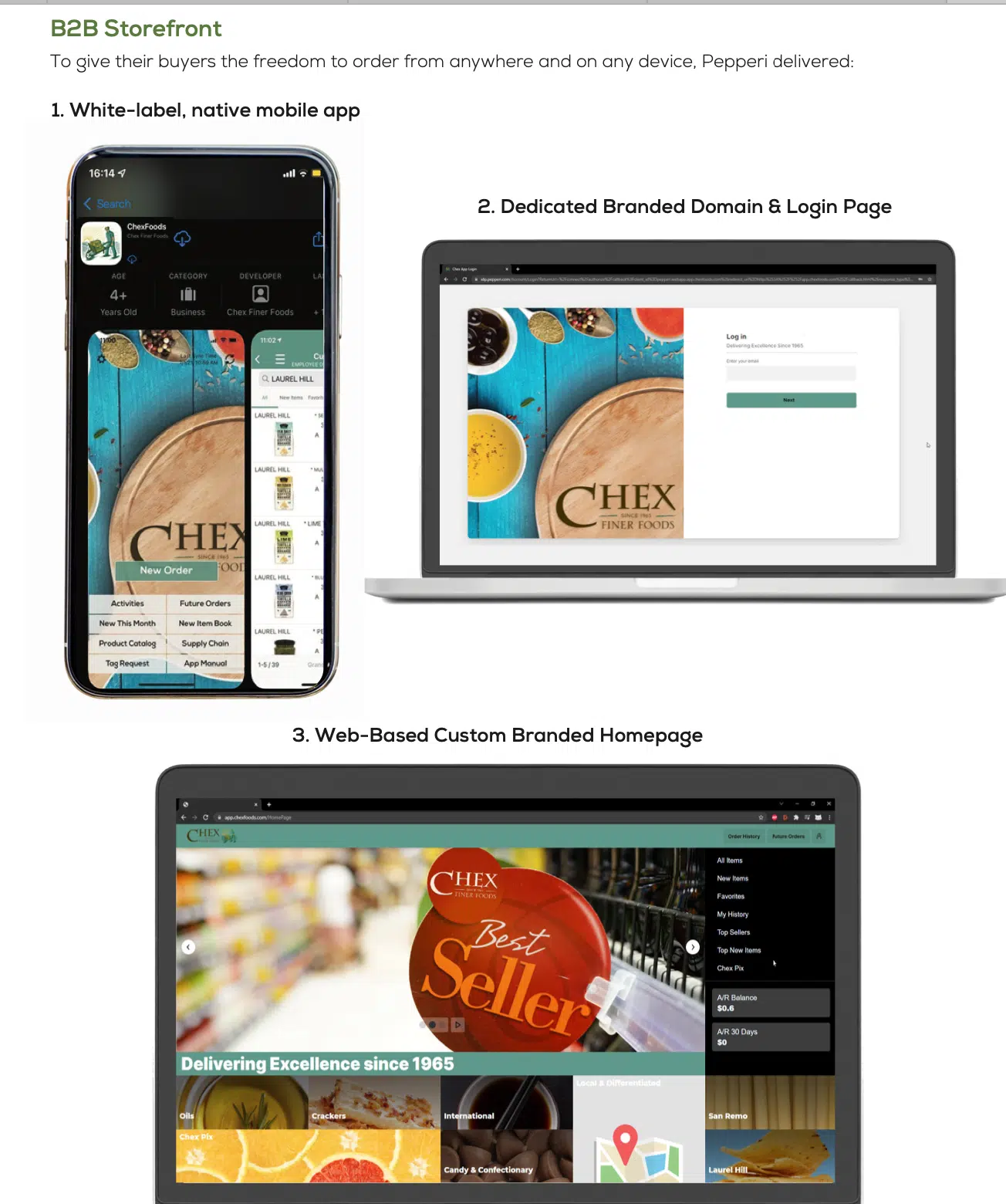
For buyers who want to see what they’re actually getting — interfaces, layouts, real screens — this format answers the question before they ask it. Product-led proof for a product-led buyer.
12. DOTVOX
The DOTVOX multi-site case study — hosted under Trapp Technology, which now owns the brand — shows how to sell a B2B product into a specific vertical with specific compliance demands.
It showcases the technology benefiting a multi-site company that needs business communications across branches — niche enough that many competing tools can’t credibly serve it.
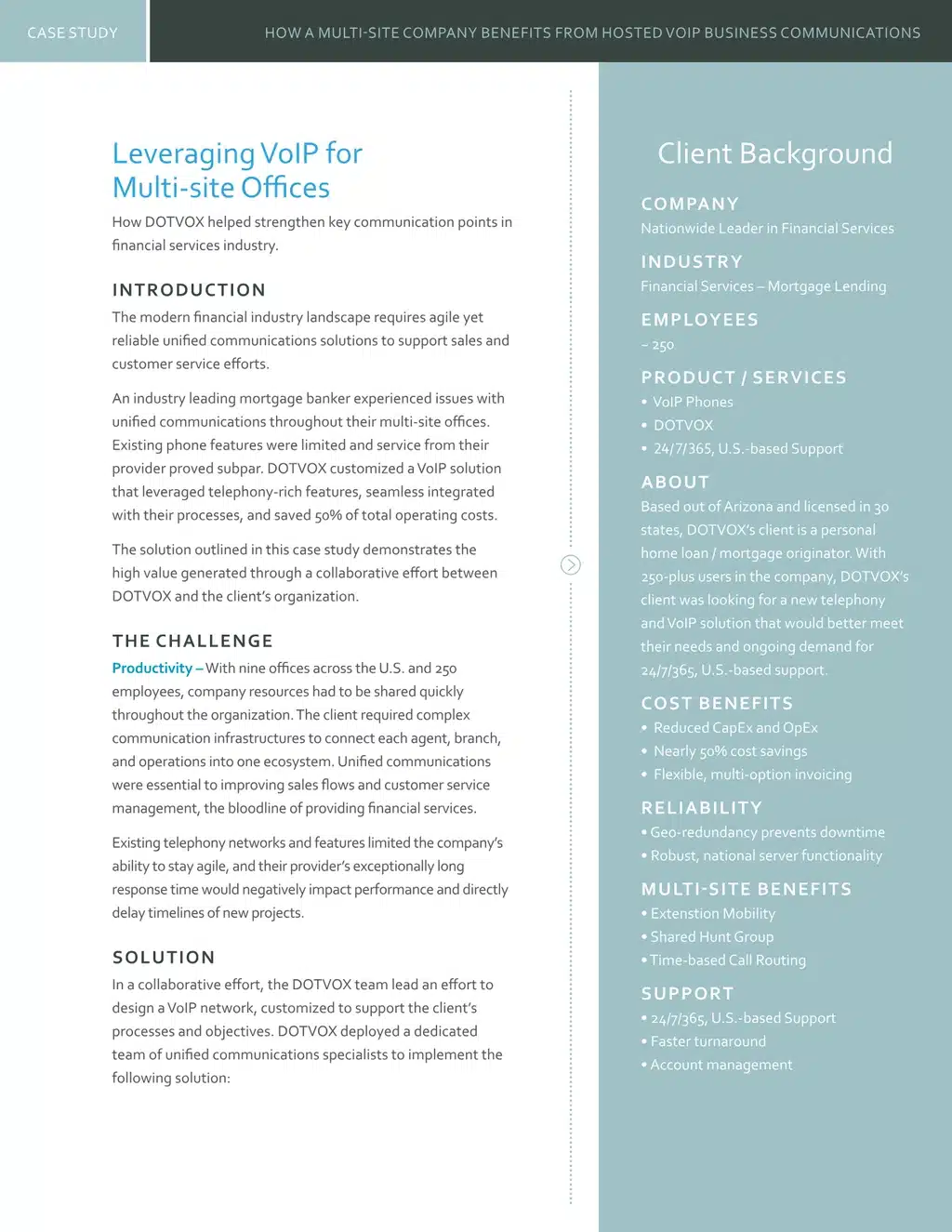
The study focuses on a financial-services client, which signals to other regulated-industry prospects — banks, mortgage lenders, insurance — that DOTVOX’s security posture is suitable for them.
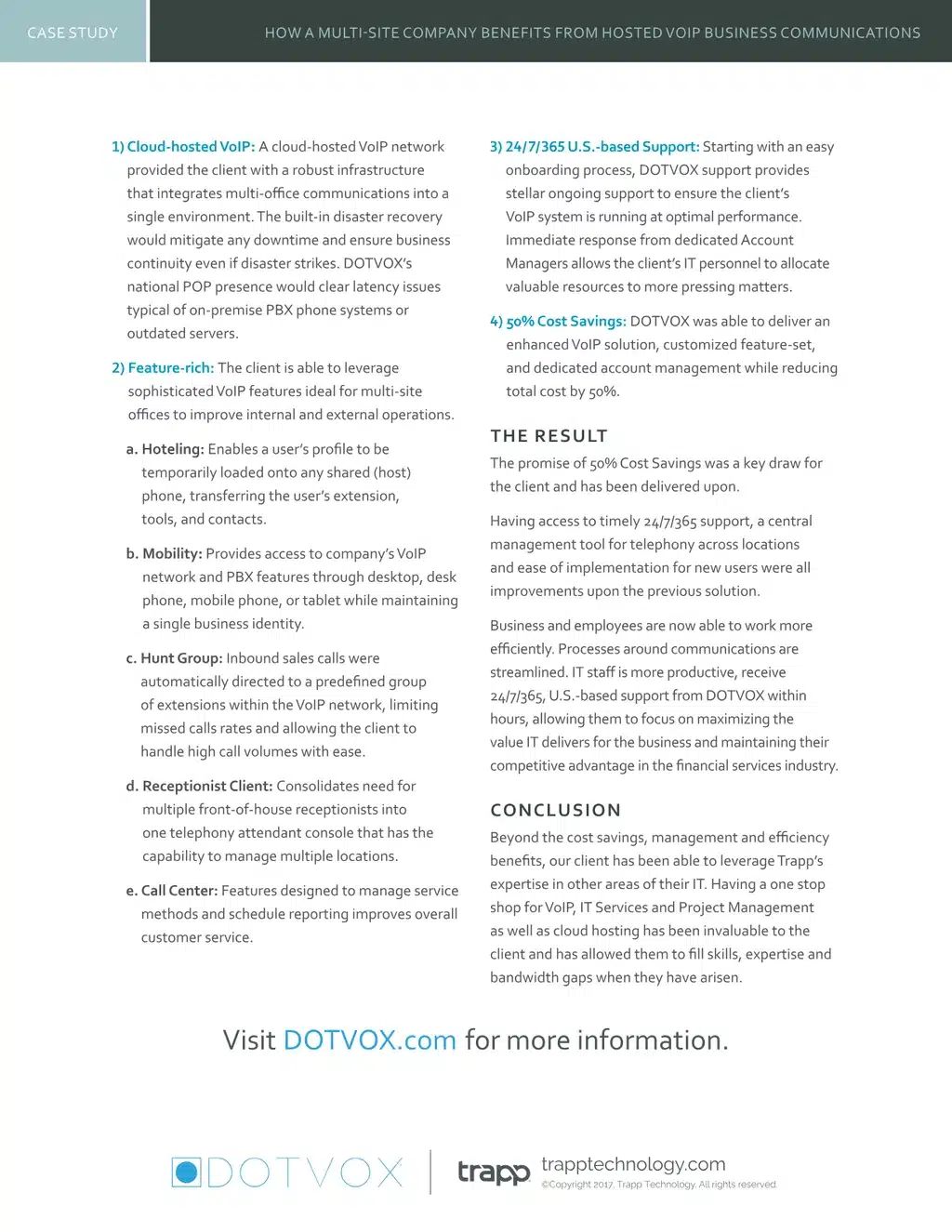
Later sections break down individual results, services, and the "Feature-rich" module that highlights capabilities competing tools don’t offer. If your product wins on a small number of niche features, surface them here, not in a generic benefits list.
For a deeper Trapp Technology VoIP example library, the Trapp case-study hub has additional current stories worth browsing.
13. PortaFab
PortaFab sells physical modular building systems — not software — which changes the case-study template.
The study opens with a project overview. The challenge sits on the right side of the module, and project benefits on the left.
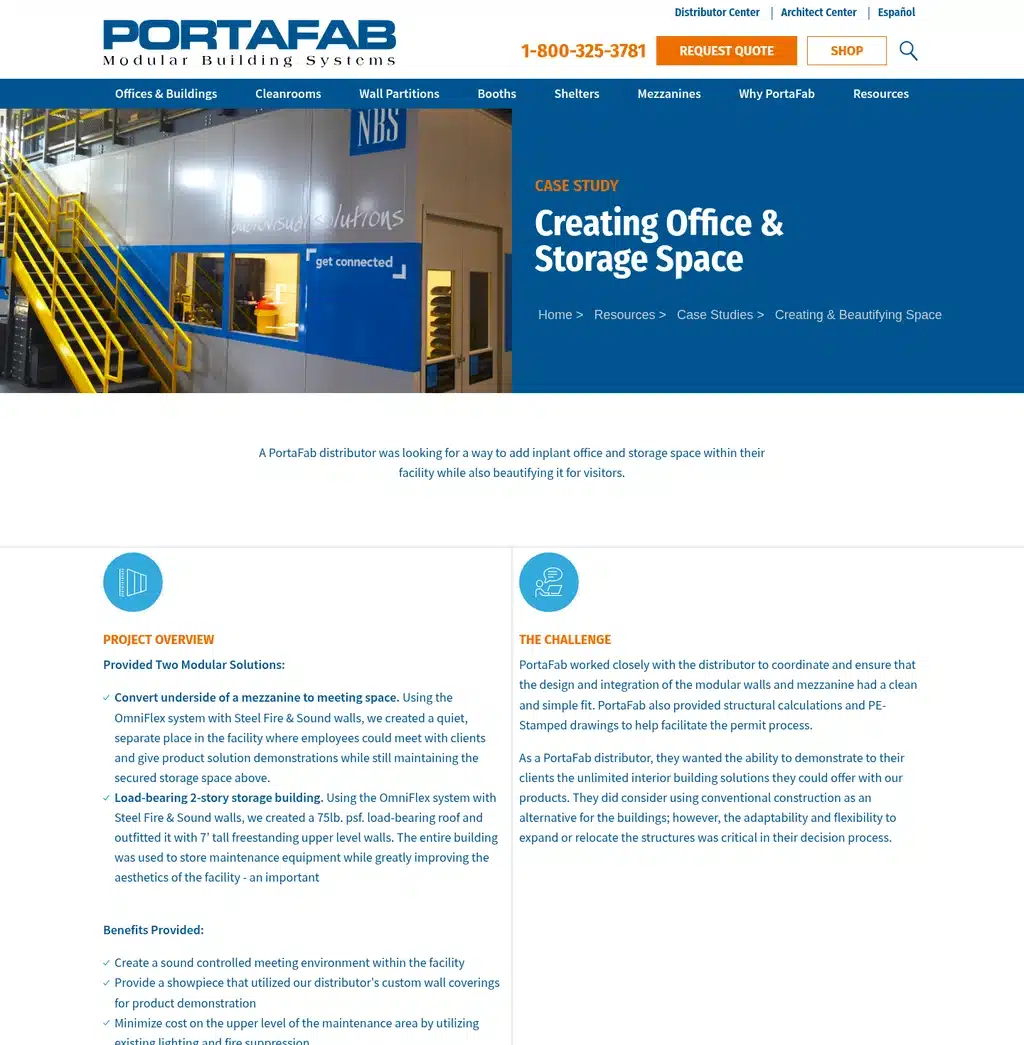
Below that sits the solution with an extensive photo gallery of the completed project.
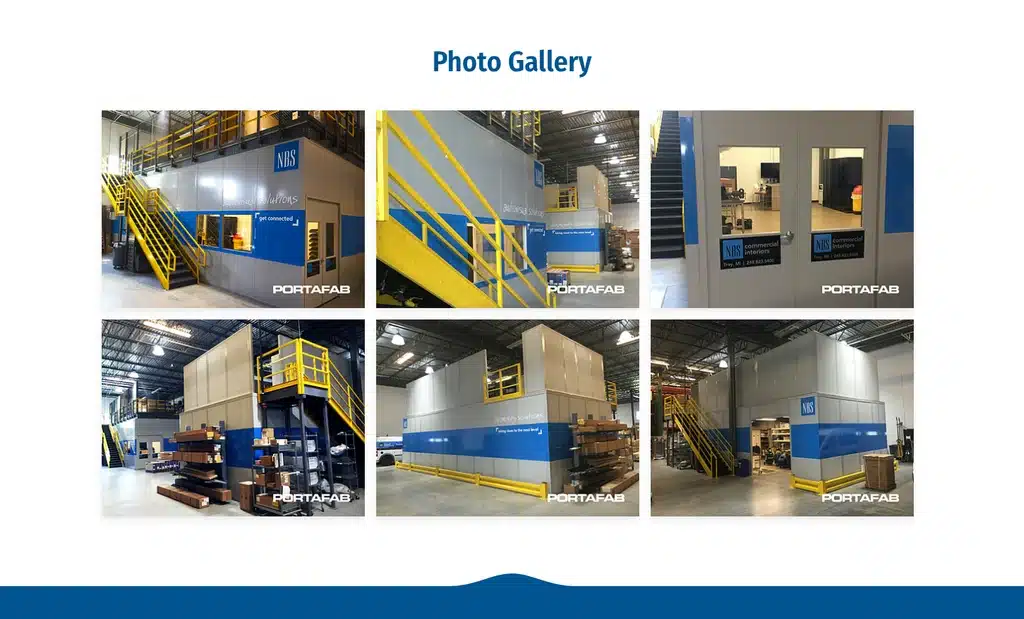
For physical products, the ability to visualize the finished result is worth more than another stat. If you’re selling anything you can point at, put photos in your case studies — not charts.
14. GitHub
GitHub’s Shopify customer story is the enterprise-ecommerce proof point to copy.
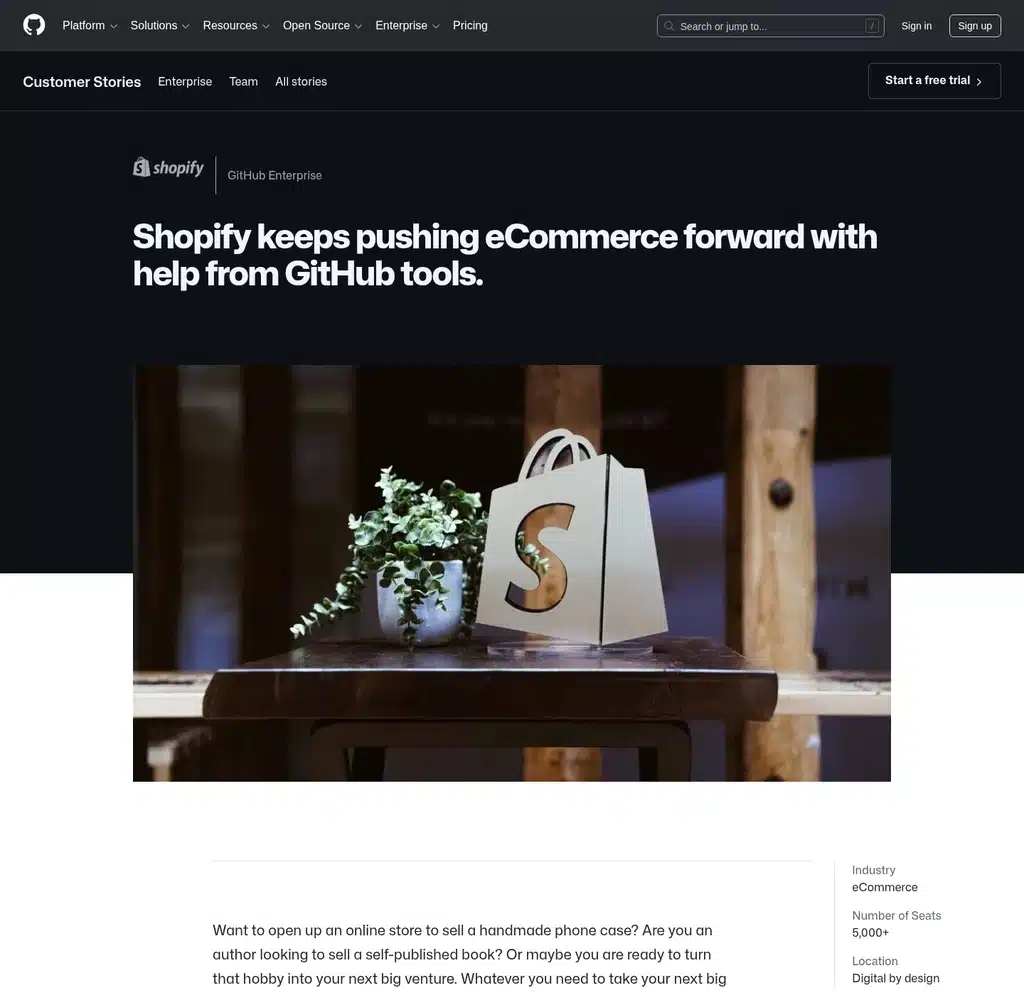
Featuring Shopify is a strategic choice: instantly recognizable, enterprise-scale, and a brand every engineering leader in GitHub’s ICP already respects. The story runs through how Shopify scales engineering with GitHub — branch strategy, CI, code review, rollout patterns — at a scope that signals this tool can handle you, whatever your size.
The layout mixes quick-hit stats at the top with longer prose below. Skimmers get the headline. Readers willing to commit 10 minutes get the depth. Both audiences are served by the same page.
Pick a flagship customer whose scale matches the ceiling of your market. That one case study will punch above every other one you publish.
15. Codeless.io
Like Breadcrumbs, Codeless.io takes a content-heavy approach to its case studies.
The Loomly case study leads with a standout result: 827% increase in CTR by updating the client’s existing content. That framing matters — it highlights a service many agencies don’t offer and tells a client who’s hesitant to invest in refreshing old content exactly what the upside looks like.

The study reads like a hybrid of a blog post and a case study. Essential company details sit off to the side, but an entire H2 section explores the business in depth before the methodology kicks in.
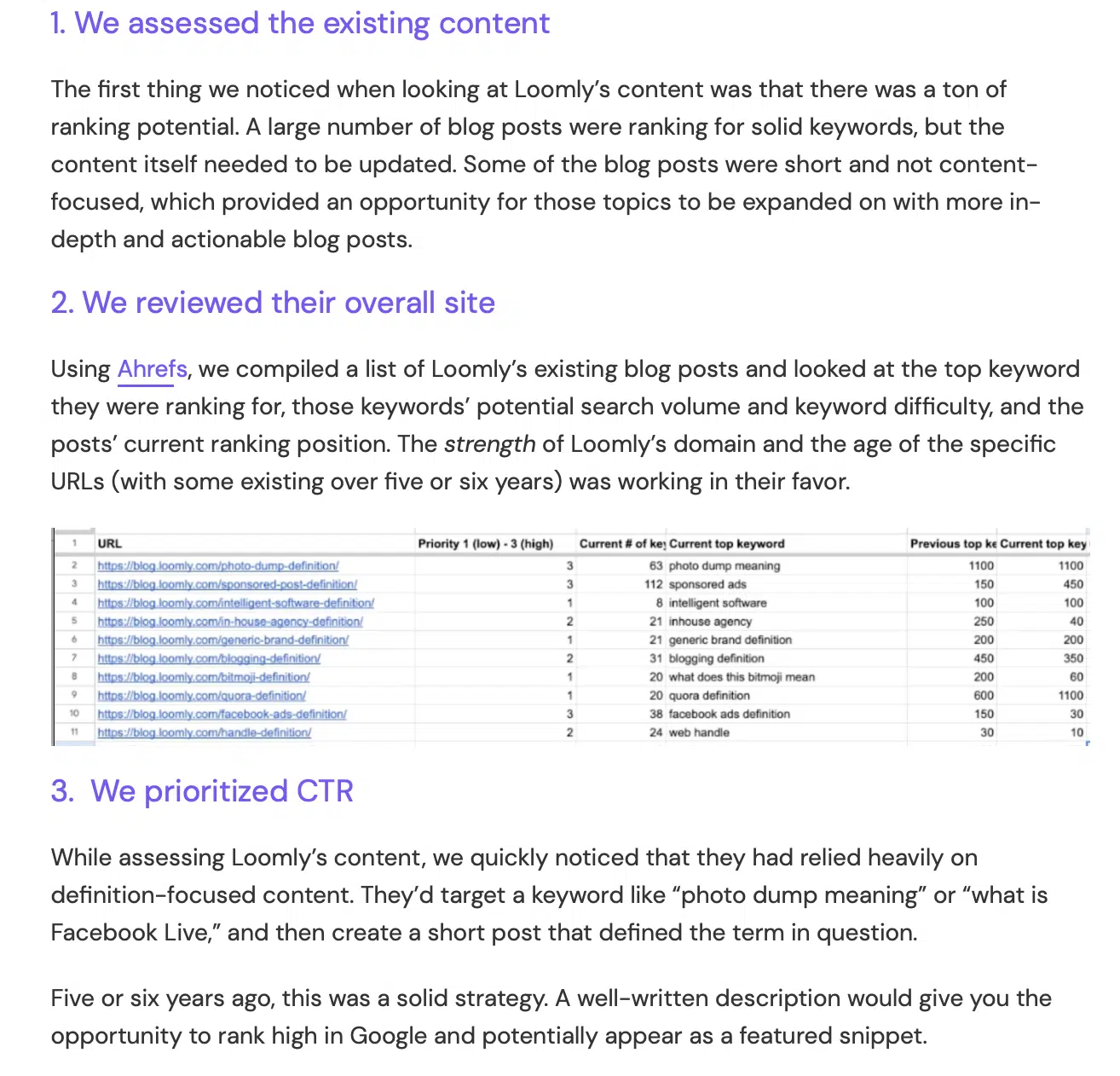
What most agencies won’t do: Codeless walks through the exact processes used to hit those results. That transparency builds more trust than any testimonial — the reader leaves the page with no doubt the result was earned, not lucked into.
16. WizeHire
WizeHire is a hiring platform, and the Barker Mazda case study is a strong example of multi-format storytelling on a single page.
The formatting is different from most on this list. Near the top, a "How We Helped" section introduces the point of contact, the client’s past pain points, and "before and after" bullets. Readers who only spend 20 seconds on the page still leave with the narrative.
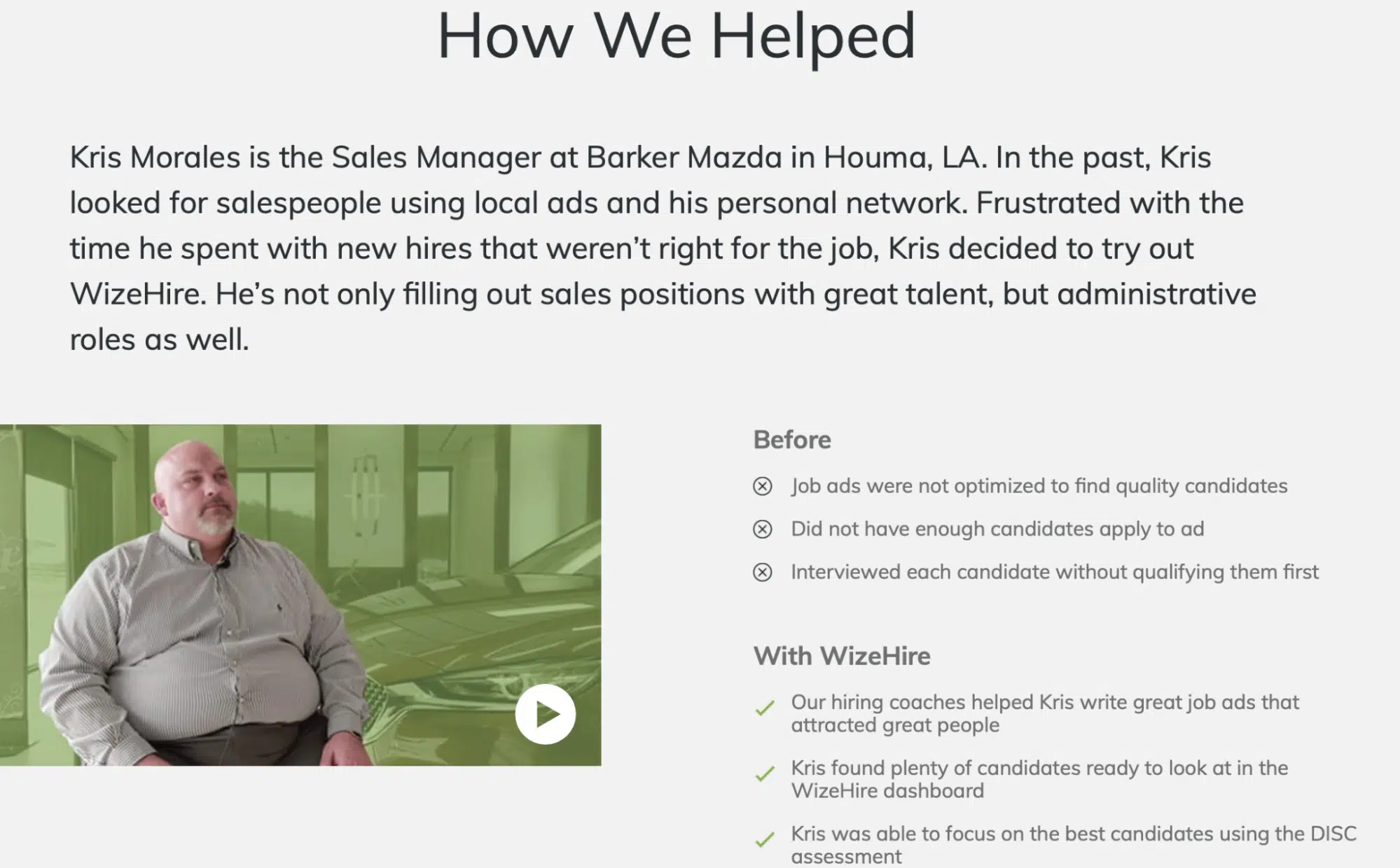
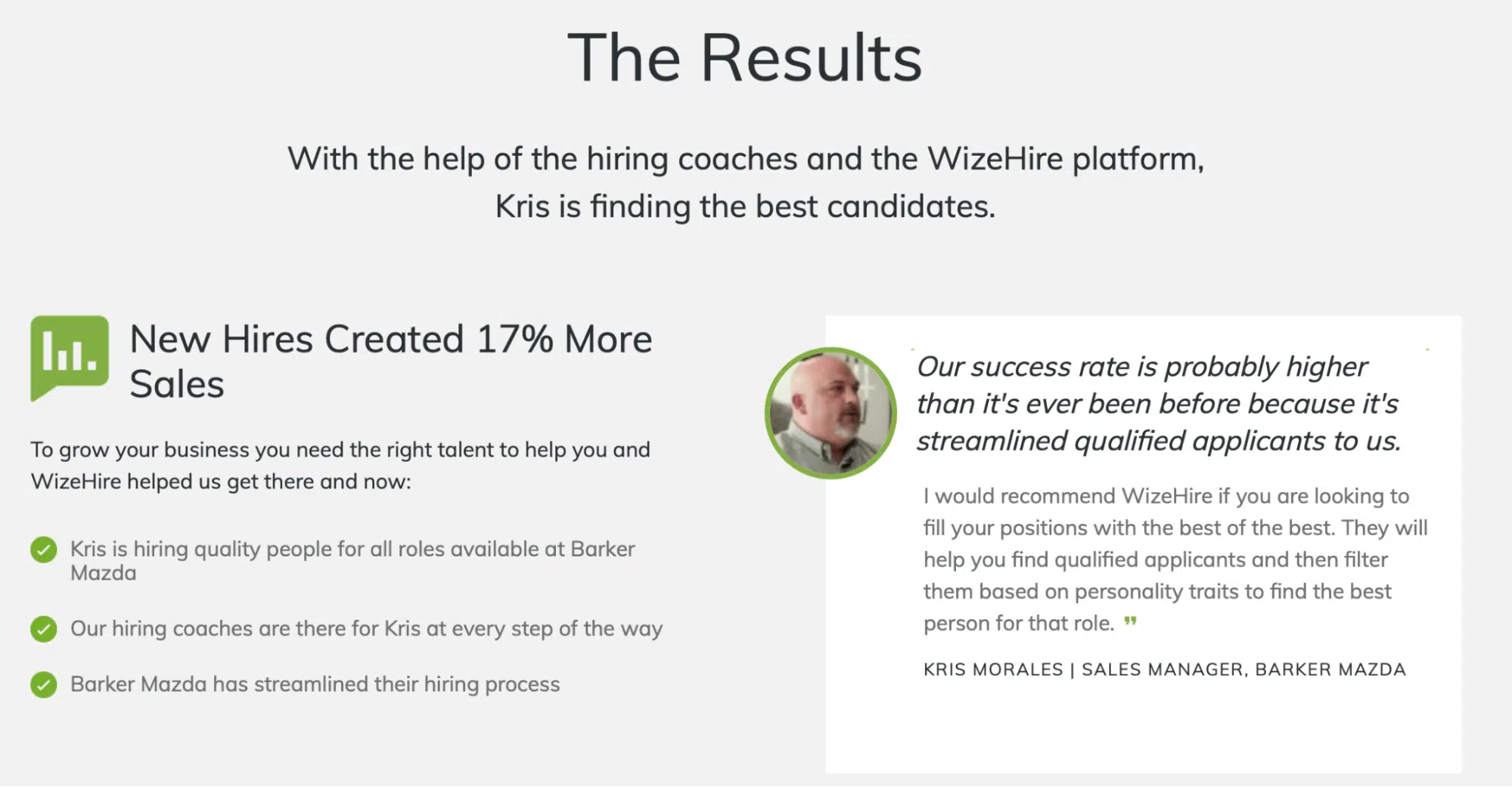
The study uses multiple media in parallel — images, video, and varied text formatting. Skimmers can run through the bullets. Committed readers can watch the client video. Either audience gets the conversion push.
A detailed results section closes the page with operator-grade stats and a strong testimonial.
17. Kosli
Kosli is a highly technical tool for software developers and DevOps teams, and its case studies prove that deeply technical topics don’t have to read like compliance documentation.
The Firi case study leads with an H1 stating the client shipped 100,000 changes without compliance anxiety. It is relatively short, which is fine — it does not need length to be effective.
The study calls out that Firi operates in Norway, which has some of the strictest regulatory requirements globally. That single geographic anchor signals to every other regulated-market buyer that Kosli can meet their bar.
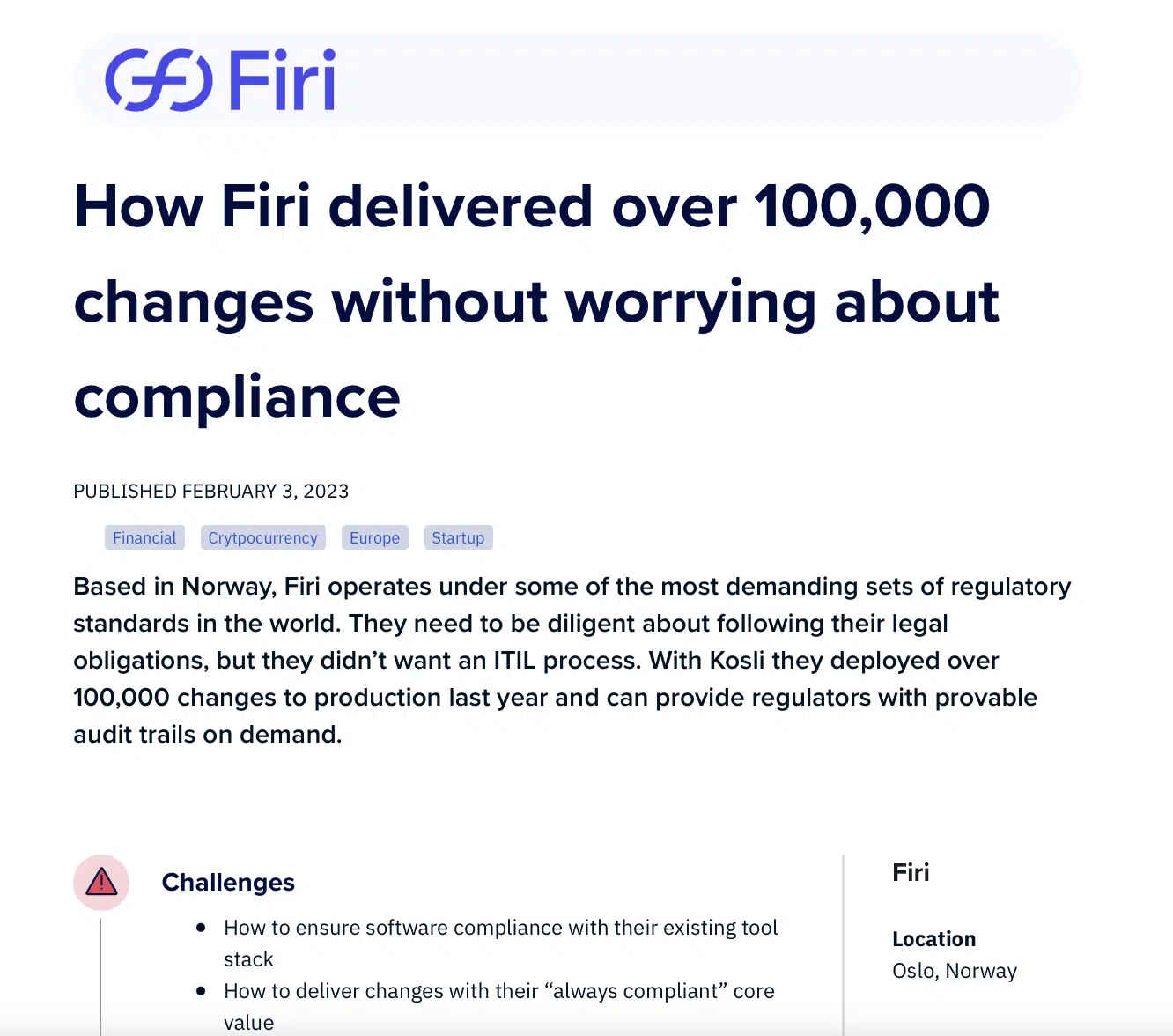
The formatting pairs common challenges with matched solutions. Each challenge has a direct "this is how we fixed it" counterpart.
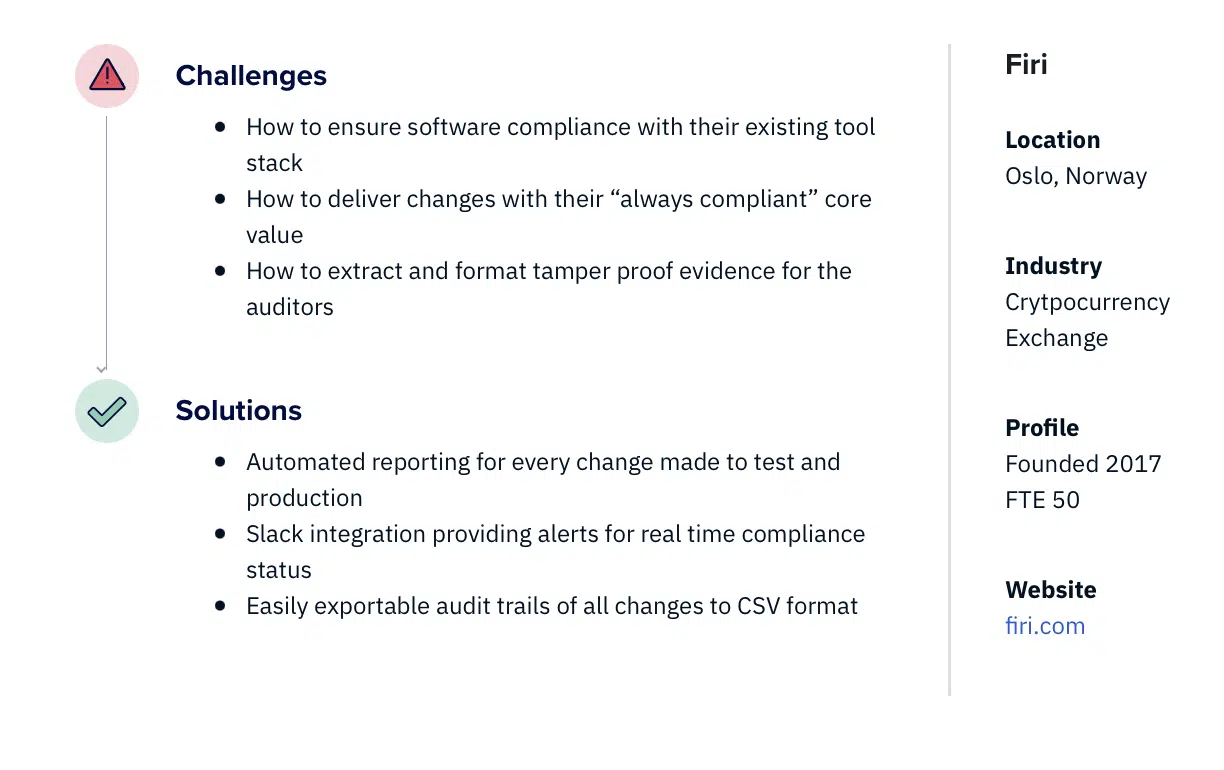
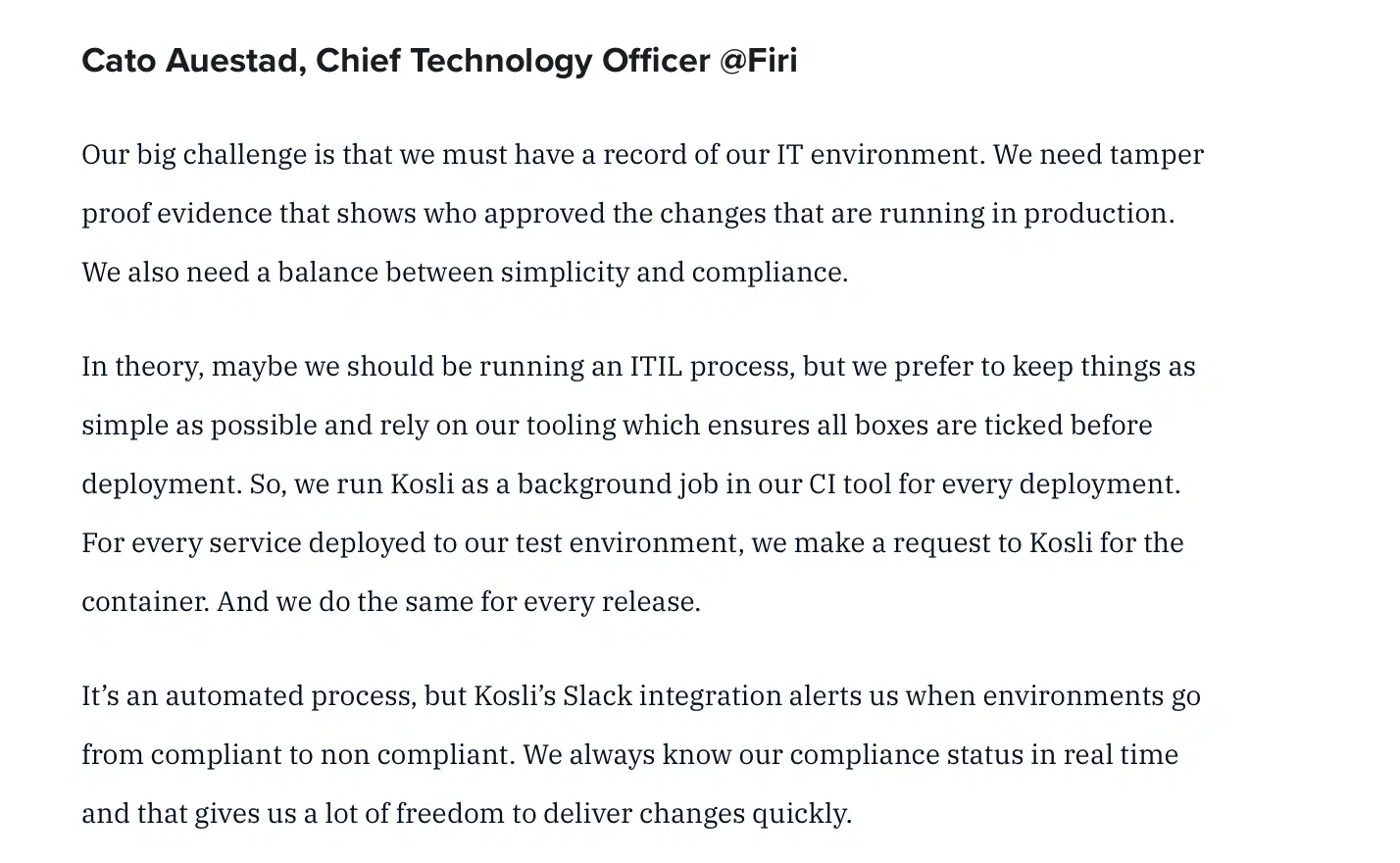
There isn’t a long list of performance stats — instead, the CTO explains, in their own words, why the software was invaluable. Sometimes the single right voice beats a dashboard of numbers.
Frequently Asked Questions
How long should a case study be?
A case study should be as long as the story needs — no longer. A one-pager works when the buyer already knows the category and just wants proof. A full report works when the deal is complex, technical, or has multiple stakeholders. The right length covers challenge, solution, and result without padding.
Sources: RingCentral; Adobe.
How do you write a good business case study?
Start with the customer, not the product. Pick a story that mirrors the segment you want more of, then structure it around the problem they faced, the specific solution they used, and the measurable outcome they got. Add a named stakeholder quote. The customer is the hero — your tool is the catalyst.
What are the key parts of a case study?
Challenge, solution, and results — every time. Stronger versions layer in customer context (industry, team size, prior tooling), proof points (screenshots, data, workflow diagrams), and at least one direct quote from a named stakeholder. Without a quote or a number, a case study is just a product brochure in longer clothes.
What are the different types of case studies?
B2B teams commonly publish long-form reports, one-pagers, videos, interactive web stories, infographics, and podcasts. Academically, case studies are also grouped as descriptive, explanatory, exploratory, intrinsic, instrumental, or collective. For marketing, the format that matches your reader’s attention window beats the one that matches a textbook.
Sources: RingCentral; Zapier.
Why are case studies important for businesses?
Case studies turn broad product claims into specific customer proof. They show a buyer the original problem, the chosen solution, and the real outcome — in a context that looks like theirs. That’s why they compound trust over time and outperform feature lists at the bottom of the funnel where the MQL-to-SQL handoff actually happens.
What makes a case study example stand out?
The best ones combine strong design, specific metrics, direct quotes from a named stakeholder, and a clearly structured story arc. A reader should be able to skim the page in 30 seconds and still know who the customer was, what changed, and why the result matters. Specificity beats polish, every time.
Sources: Zapier; RingCentral.
Final Thoughts
There is no one-size-fits-all shape for a B2B case study. The format, length, and framing should follow the buyer, the product, and the stage of the funnel the case study lives in.
Start with a clear customer profile, pick a story that mirrors it, and borrow the template from the example on this list that most resembles your situation. The only rule that never changes: show the work, quote a named human, and let the result speak first.
Once the case studies start driving traffic, the next problem is qualifying the leads they bring in. Our B2B lead scoring guide and our lead scoring criteria breakdown cover the scoring side of the handoff — so the pipeline that case studies generate actually converts.