
Last updated: May 10, 2026
Most competitor decks read the same: a feature table, a logo grid, a vague "we're better at X." That tells you nothing about where the competitor is exposed, where they're about to move, or what your sales team should say next. A competitor SWOT fixes that — if you run it like a practitioner, not a textbook.
This guide walks through a five-step workflow, a free template, a frameworks comparison, a B2B SaaS example, and an FAQ. Run it on one priority competitor and sales, product marketing, and RevOps can act on the output by end of day.
Table of contents
- What is a Competitor SWOT Analysis?
- SWOT vs Other Competitive Analysis Frameworks
- When to Conduct a Competitor SWOT Analysis
- 5 Steps to Conducting an Effective Competitor SWOT Analysis (includes the free template and an AI sidebar)
- Final Thoughts
- Frequently Asked Questions
What is a Competitor SWOT Analysis?
A competitor SWOT analysis is a structured assessment of a single competitor's Strengths, Weaknesses, Opportunities, and Threats, built from external evidence — pricing pages, reviews, win/loss interviews, product changelogs, sales notes — and used to shape positioning, pricing, roadmap, and sales plays. It's a snapshot, not a strategy.
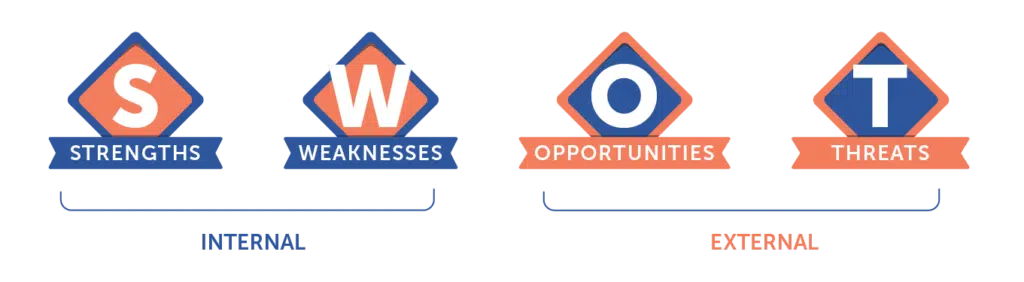
SWOT splits a competitor's reality into two halves: the internal (Strengths, Weaknesses) and the external (Opportunities, Threats). Strengths and Weaknesses describe what the competitor is and how they show up today. Opportunities and Threats describe the market conditions — buyer behavior, regulation, AI shifts, category churn — that could lift or sink them.
Why run it on a competitor and not just yourself? Because you already know your own pricing, your own gaps, your own roadmap. The leverage is in seeing the competitor through the buyer's eyes, then deciding what to change about your own go-to-market in response.
SWOT vs Other Competitive Analysis Frameworks
SWOT is the right tool for a fast, competitor-specific snapshot. It is the wrong tool for industry economics, macro risk scans, sales enablement, or buyer-backed loss reasons. Use the table below to decide whether SWOT is the framework you actually need — or whether you should pair it with PESTEL, Porter's Five Forces, battlecards, or win/loss before you start.
| Framework | Best use case | Time to run | Primary output |
|---|---|---|---|
| Competitor SWOT | Fast competitor-specific snapshot — where a rival is strong, weak, exposed, or likely to move next. | 1–3 hours desk-research; 1–2 days with reviews, sales notes, interviews. | A 2×2 matrix per competitor, prioritized into actions. |
| PESTEL | Macro-environment scan before market entry, category expansion, or regulation-heavy planning. | Half day to one day. | Political, economic, social, technological, environmental, and legal risk and opportunity list. |
| Porter's Five Forces | Industry attractiveness and profit-pool analysis before entering a market. | 1–2 days for a useful first pass. | Industry-structure view: entrants, suppliers, buyers, substitutes, rivalry. |
| Battlecards | Sales enablement for live competitive deals after the strategy work is done. | 2–4 hours per competitor; maintain continuously. | Sales-ready card with competitor strengths, objections, differentiators, proof, and talk tracks. |
| Win/loss analysis | Explaining why buyers chose you or a competitor after real deals close. | Ongoing program; 30–45-minute interviews per deal plus monthly synthesis. | Buyer-backed themes, loss reasons, competitor tags, messaging and product gaps. |
A note on win/loss specifically: Clozd's 2023 State of Win-Loss Analysis report, with Pragmatic Institute, found CRM closed-lost reasons were materially wrong in roughly 85% of the deals they re-interviewed. If your SWOT is built off CRM loss reasons alone, expect it to be wrong. Pair SWOT with even a small win/loss program and the bullets sharpen fast.
When to Conduct a Competitor SWOT Analysis
Run a competitor SWOT when something specific changes — not on a quarterly calendar reflex. The five most common B2B SaaS triggers are a sudden rise in losses to one rival, a new category entrant, a competitor's pricing or packaging change, an upcoming launch, and an expansion into a new market or segment. Pick the trigger, pick one competitor, and limit scope.
When you're losing deals or your win rate is dropping
The cleanest trigger is a CRM signal: closed-lost rate against a single competitor jumps two quarters in a row, or your sales team starts mentioning the same name in deal reviews. That's not "feeling stagnant" — that's a measurable shift, and SWOT is fast enough to respond inside the same quarter.
Pull the deals you've lost to that competitor in the last 90 days. Read the call transcripts and the loss-reason notes. Where you can, run short win/loss interviews with the buyers who chose them — five conversations will tell you more than five hundred CRM rows. SWOT then becomes the place where you collect that evidence into something you can argue with.
When a new category entrant shows up
A new entrant is a SWOT trigger because the analysis is half-blind from day one — there's no five-year customer base, no AppExchange footprint, no third-party reviews to lean on. The Strengths column is whatever they wrote on their homepage. The Threats column is what they could become if their funding round and hiring plan suggest velocity.
Read their pricing page, their changelog, their open job posts, and their founder content. Job posts in particular are signal: they reveal where the new entrant is investing — often a product or category they haven't yet announced. Build the SWOT light, then re-run it in 90 days when there's evidence to refine it.
When a competitor changes pricing or packaging
A pricing or packaging change is the rare competitor move that deserves a same-week response. It signals where they think margin is, what segment they're chasing, and where they've decided to cede ground. Capture it with a SWOT specifically focused on that change — not a full company teardown.
What to look at: the new tiers, what features moved up or down, what's now metered, what's now bundled, and whether they introduced a free or low-touch entry point. Cross-reference against how the change affects MQL-to-SQL handoff — pricing changes often pull lower-fit buyers into your top-of-funnel. The SWOT then drives a pricing test, a sales talk track, or a packaging counter-move.
When you're launching a new product or feature
A SWOT before launch keeps your messaging honest. It forces a real comparison against the competitor's adjacent product or feature: do they actually do this, or do their slides say they do? What does it cost? How long does it take to set up? What do reviewers complain about?
The data inputs that matter for launch SWOT are concrete: their product docs, their pricing tiers, their changelog, recent customer demos on YouTube, support and community forums, and G2 or Capterra reviews filtered to the last 12 months. Pulling the SWOT lets you sharpen the launch messaging — what you're claiming, what you're carefully not claiming, and what your sales team should expect to hear in objections.
When you're expanding into a new market or segment
When you move up-market, into a new geography, or into a vertical you haven't sold into, the SWOT shifts: now you're profiling a competitor you may have never lost to before. Their distribution and brand recognition in that segment may dwarf yours. Their integrations may already be set up.
Use SWOT to map where they're advantaged in the new segment and where you can pick a fight. Pair it with PESTEL or Five Forces if there's macro or regulatory complexity (financial services, healthcare, EU data residency). And lean on marketing attribution data to identify which channels they own in that segment so you can plan around them, not into them.
5 Steps to Conducting an Effective Competitor SWOT Analysis
The five-step workflow below is built for one competitor and one trigger. Yes, you could ask AI to summarize a SWOT in 30 seconds, but you can also use AI to predict your competitor's next move and still need the human strategic call at the end. The steps make sure that call is grounded.
Free competitor SWOT template — fill this in for one competitor as you work through the steps below. Don't try to make it pretty; make it specific. Every cell should answer "what's the evidence?" before "what's the bullet?"
| Helpful (gives them an edge) | Harmful (works against them) | |
|---|---|---|
| Internal (the company itself) | Strengths — What they do well today
e.g., 250+ paid integrations · top G2 ranking in category · category-defining brand · sub-30-day implementation |
Weaknesses — Where they fall short
e.g., poor support reviews · clunky onboarding · pricing complaints from SMB segment · gap in EU data residency |
| External (the market they operate in) | Opportunities — Outside conditions they could ride
e.g., underserved mid-market ICP · pricing gap below $25k ACV · AI-search visibility gap · new partner ecosystem |
Threats — Outside conditions that could hurt them
e.g., cheaper category entrant · platform vendor entering category · new compliance regime · macro pullback in their core segment |
Want a working copy? Grab the free competitor SWOT template (Google Sheets / Excel) — or the printable PDF for in-meeting use. One competitor per sheet; all dropdowns and prompts are pre-wired.
One competitor per template. If you need to cover three competitors, run three SWOTs and compare them in a fourth document.
1. Identify your target competitor
Pick one competitor. Not three, not your full landscape map. The trigger that prompted the SWOT usually tells you who: the competitor your CRM keeps surfacing in lost deals, the new entrant your team is asking about, the player who just changed pricing.
Then pick the type of competitor consciously. Direct competitors sell a similar product to a similar buyer. Indirect competitors solve the same problem with a different shape of solution — for a B2B lead scoring tool, that's CRM-native scoring or a manual spreadsheet model. Potential competitors aren't in your category yet but have the data and distribution to enter it (think CRM platforms quietly building scoring features). Run the SWOT on the competitor whose moves actually affect pipeline this quarter.
2. Gather information from the competitor
Skip the generic "browse their website" advice. The data sources that produce a usable B2B SaaS SWOT are specific, free, and sit in a handful of places.
- Pricing page and packaging tiers. Read them line by line. What's gated to higher tiers? What's now metered? What did they remove? Pricing pages encode strategy.
- Product changelog and release notes. A 12-month changelog tells you their roadmap better than any deck. Look for cadence, theme, and what's conspicuously absent.
- G2, Capterra, and TrustRadius reviews. Filter to the last 12 months. Mine 1–2-star reviews for weaknesses; mine 5-star reviews for strengths buyers actually cite. Reviewers reveal onboarding friction and integration gaps that marketing pages hide.
- Win/loss transcripts and lost-deal notes. The 2023 State of Win-Loss Analysis report found CRM loss reasons were wrong roughly 85% of the time. Use the call transcripts and rep notes, not the dropdown.
- Sales call notes from your own team. Your AE bench has heard objections, comparisons, and "the other vendor said…" lines for a year. Pull a sample.
- Product documentation, help center, and API docs. Doc depth signals product depth. Thin docs = recent build or recent rewrite.
- Open job posts. Job posts leak the roadmap. A competitor hiring three Forward Deployed Engineers is investing in implementation; one hiring four growth marketers is changing GTM.
- Customer-facing content, newsletters, and blog posts. What ICP are they writing for? Whose attention are they trying to buy?
- Earnings calls, S-1s, and analyst reports if they're public.
Avoid the hallway "I heard from a friend at their company" inputs. SWOT bullets stand up under pressure only when they have a source.
Sidebar: Can you use AI to run a competitor SWOT?
You can use AI to speed up a competitor SWOT, but not to outsource the judgment. Use it to summarize source material, cluster review themes, compare positioning pages, and extract transcript snippets. Then verify every bullet against a source and decide which findings are strategically important.
A practical prompt pattern: feed the model the competitor's pricing page, last six months of changelog entries, and 30 recent G2 reviews. Ask it to draft SWOT bullets where each line includes the source URL or quote, the date, and a confidence flag (high / medium / low). Reject any bullet without a source. The OECD's 2025 report on AI and competitive dynamics flags hallucination and overreliance as the dominant failure modes — and the strategic-interpretation step (what matters, what's noise, what to do about it) is exactly where the human still earns the call.
3. Use the SWOT matrix to organize your data
Open the 2×2 template above. Take one competitor's worth of evidence and place each item into the right quadrant. Resist the temptation to fill every box — empty cells are diagnostic.
It is good practice to run a SWOT on your own company in parallel and place the matrices side by side. The interesting cells are the ones where your weakness is their strength, or your opportunity is their threat. That's where the action lives.
Strengths
Identify what the competitor genuinely does well — verified by reviews, customer quotes, or measurable outcomes. For a B2B SaaS competitor, common real strengths include a deep integration ecosystem, switching costs from existing data and workflows, fast time-to-value (sub-30-day implementations), high-intent category content that owns the SERP, named customer logos with public case studies, and pricing that fits a specific buyer persona well.
If their entire "strengths" column comes from your sales reps' anxiety rather than buyer evidence, throw it out and rebuild. SWOT is only as good as its sourcing — a point Therese Fessenden at NN/g makes plainly: SWOT is useful when it clarifies how well a product is positioned to serve customers in a market, not when it serves as a self-soothing exercise.
Weaknesses
Where do the buyer reviews push back? What are reps reporting from competitive deals? Common B2B SaaS weakness patterns include onboarding friction (long implementation, expensive services attach), missing integrations with the buyer's actual stack, weak support (response times, ticket dead-ends), stale positioning ("AI" still bolted on as a 2023 talking point), pricing complaints from a specific segment, and a thin reporting layer.
Pull at least three direct quotes from reviews or transcripts to back each weakness bullet. "Bad UX" without a quote is opinion. "Three reviewers in the last 90 days called the import wizard 'broken'" is a weakness with teeth.
Opportunities
Opportunities are external conditions the competitor could ride if they noticed. They're the watch-list. Common B2B SaaS opportunity examples: an underserved ICP segment they're not yet targeting (mid-market they've ignored, or a vertical they haven't built for), a pricing gap they could fill if they introduced a lighter tier, an AI-search visibility gap their content team hasn't closed, or a partner ecosystem opening (a new integration platform, a vendor consolidation play).
Identify their opportunities so you can either move first or harden against the move. If you spot a clear underserved ICP they could capture, that's also a SWOT input for your roadmap — assuming the segment fits your ICP too.
Threats
Threats are external conditions that could hurt the competitor regardless of what they do. Cheaper category entrants. Platform vendors entering the category from above (CRMs adding scoring; data warehouses adding activation). New compliance regimes — DSA, EU AI Act, sector-specific rules. A macro pullback in their core ICP. A shift in buyer behavior toward consolidated platforms.
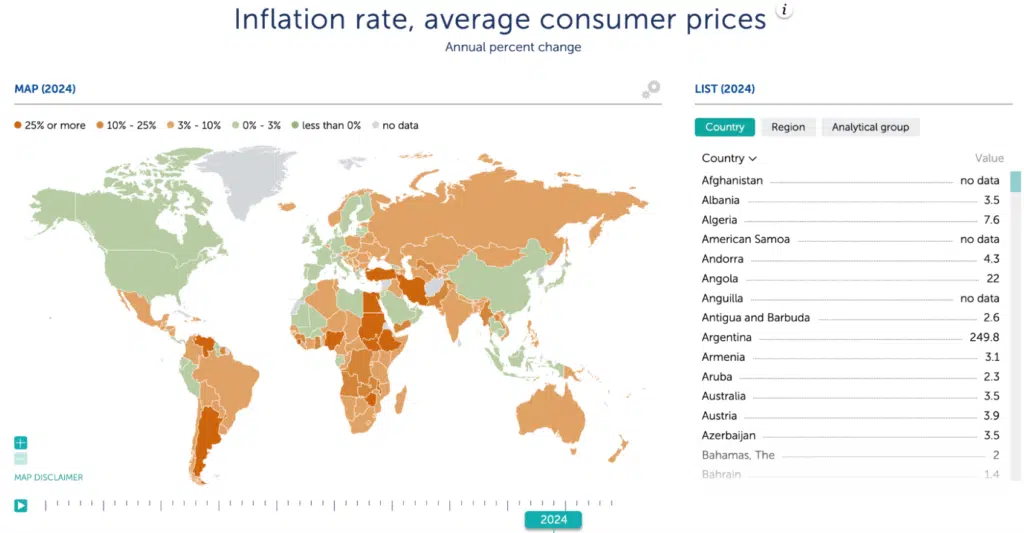
Macro inflation snapshot from the IMF's WEO DataMapper — useful as a backdrop for macro-economic threat lines, not as the threat itself.
Macroeconomic backdrop is a threat input, not the whole column. The IMF inflation map above is the kind of evidence you'd cite for a "buyer budget compression" threat — but the actionable threat is what specifically gets cut from your competitor's pipeline if their core ICP tightens spend.
Worked example: B2B lead scoring software vs CRM-native scoring
The clearest way to ground SWOT is on a competitor archetype your readers will recognize. Anonymized example: you sell a B2B lead scoring product, and your most common indirect competitor is "scoring built into the CRM" (Salesforce, HubSpot, or similar).
| Helpful | Harmful | |
|---|---|---|
| Internal | Strengths — Already in the buyer's CRM. No new tool to procure. Native fields, native reporting, no integration risk. Procurement-friendly. | Weaknesses — Single-source data (only what the CRM sees). Limited or no activity-signal scoring. Manual rules, hard to maintain at scale. No model decay handling. |
| External | Opportunities — CRM platform investing in AI/ML scoring features. Expanding revenue cloud into RevOps territory. Buyers tightening tool stacks. | Threats — Specialized scoring vendors with multi-source data and decay logic. Buyer demand for product/PLG signals the CRM doesn't capture. Reviews calling out "couldn't get scoring to work in HubSpot" as a churn driver. |
The SWOT lands on a single positioning move: lean into the multi-source / activity-signal / model-quality story, because the CRM-native option is structurally limited there. The opposite move — competing on "we live in your CRM" — would walk into your indirect competitor's strongest cell.
4. Analyze your findings
This is where SWOT either pays off or dies. Filling a 2×2 isn't analysis. Patterns inside the matrix are.
Use a pattern → implication → action mini-method on each quadrant pair. Three concrete patterns to look for:
- Pattern: Their strength is your weakness. Implication: you'll lose head-to-head deals on that dimension unless something changes. Action: pick — neutralize (sales talk track, proof point, integration), counter (build the capability), or avoid (segment-out of the deals where this dimension dominates).
- Pattern: Their weakness shows up repeatedly in customer reviews. Implication: there's a buyer-validated angle for messaging or sales positioning. Action: feed the language directly into a battlecard, a pricing test, or a "switch from X" campaign.
- Pattern: An opportunity sits in their column but also fits your ICP. Implication: it's a race — first mover on the underserved segment, the new partnership, or the AI-search visibility window will probably keep it. Action: assign an owner and a deadline. Unowned opportunities decay.
The Competitive Intelligence Alliance frames this clearly: SWOT isn't actionable on its own. It becomes actionable when each bullet is converted into a decision a specific person can make this week.
5. Identify next steps and take action
A SWOT that doesn't ship a decision is a slide deck. Map every prioritized finding to one of six concrete output types — these are the artifacts your RevOps, marketing, product, and sales teams already use:
- Battlecard. Strength and weakness lines feed sales: how to position, how to handle the objection, what proof to deploy. The Product Marketing Alliance battlecard template is a clean starting structure.
- Messaging update. When the same competitor weakness shows up across reviews, calls, and lost-deal notes, that's language to put on a homepage, a category page, or a comparison page.
- Pricing test. A pricing or packaging gap in their column is a hypothesis you can test — a new tier, a metered add-on, a 90-day public price experiment.
- Roadmap input. Repeated weakness or missing-integration signals turn into product backlog items. Don't pretend SWOT replaces discovery — it's an input alongside customer interviews.
- Campaign angle. A "switch from X" or "alternatives to X" campaign earns its keep when the competitor's weaknesses are buyer-validated. Pair it with marketing attribution so you can measure response rather than guess.
- Win/loss interview question. Every SWOT bullet that's still uncertain should turn into a question on the next ten win/loss interviews. SWOT is a hypothesis generator; win/loss is the test.
Whatever you ship, write down: the goal, the owner, the deadline, and the metric you'll use to know whether the move worked. SWOT outputs without owners drift. SWOT outputs with owners and a 30-day check-in compound across cycles.
Final Thoughts
A competitor SWOT analysis is not a strategy. It's a fast, evidence-driven snapshot of a single competitor that lets you decide where to push, where to pull back, and where to run a sharper test. Done well, it ships in an afternoon and informs four or five decisions across sales, marketing, product, and pricing.
Run it on a trigger, not a schedule. Source every bullet. Pair it with battlecards and win/loss when you need sales-readiness or buyer-truth. And re-run it any time the competitor — or the market — meaningfully moves. The 2×2 doesn't change. What changes is the quality of the evidence you put in it and the discipline of the actions you ship out of it.
Frequently Asked Questions
Can you do a SWOT analysis on a competitor?
Yes. A competitor SWOT analyzes another company's strengths, weaknesses, opportunities, and threats so you can understand where they are advantaged, vulnerable, exposed, or likely to move next. Use external evidence — pricing pages, reviews, customer feedback, product updates, sales notes, and market data — rather than internal guesses.
What are the 4 P's of competitor analysis?
The 4 P's are product, price, place, and promotion. They help you compare what a competitor sells, how they price it, where they distribute it, and how they market it. Use them alongside SWOT when you need more tactical marketing inputs — SWOT covers strategic posture, the 4 P's cover go-to-market mechanics.
What are the 4 types of competitors?
The four common competitor types are direct competitors, indirect competitors, replacement alternatives, and potential future entrants. For a SWOT, prioritize the competitors your buyers actually compare you against. Then add indirect or emerging competitors only when they affect positioning, pricing, or pipeline — not as a completeness exercise.
What are the 4 types of SWOT analysis?
SWOT has four quadrants: strengths, weaknesses, opportunities, and threats. Strengths and weaknesses are usually internal to the company being analyzed. Opportunities and threats are external — market conditions, competitor moves, customer shifts, regulations, or technology changes that could help or hurt performance over the next several quarters.
What are the 5 steps of a competitive analysis?
A practical competitive analysis follows five steps: identify priority competitors, gather evidence, compare product and positioning, organize findings in a framework such as SWOT, and turn the findings into decisions. The final step matters most — update messaging, pricing, roadmap, campaigns, or sales battlecards. Frameworks without follow-through don't move pipeline.
What has replaced SWOT?
SWOT has not been fully replaced, but teams often pair it with PESTEL, Porter's Five Forces, win/loss analysis, or battlecards. SWOT is best for a fast strategic snapshot of one competitor. Use the others when you need macro risk, industry economics, buyer-backed feedback on closed deals, or sales-ready competitive plays.